


Overview
and a Tree Toad
Karnataka begins declaring Apis cerana its State Insect and the Malabar Tree Toad its State Amphibian.
Karnataka announced on the International Day for Biological Diversity, 22 May 2026, that the process is under way to officially declare Apis cerana (the Asiatic honey bee) as the State Insect and the Malabar Tree Toad as the State Amphibian. Apis cerana is a native Asian honey bee species and a key pollinator of Western Ghats flora including Neelakurinji. The Malabar Tree Toad is an arboreal toad endemic to the Western Ghats biodiversity hotspot. The announcement also named four new Biodiversity Heritage Sites under the Biological Diversity Act, 2002.
What Karnataka announced on 22 May 2026
The announcement and the wider biodiversity day context
Karnataka Forest and Environment Minister Eshwar Khandre announced on Friday, 22 May 2026, that the State Government is now formally processing the official declaration of Apis cerana as the State Insect and the Malabar Tree Toad as the State Amphibian. The announcement was delivered at the International Day for Biological Diversity celebration of 2026, as reported by The Hindu, alongside a broader Karnataka biodiversity policy package.
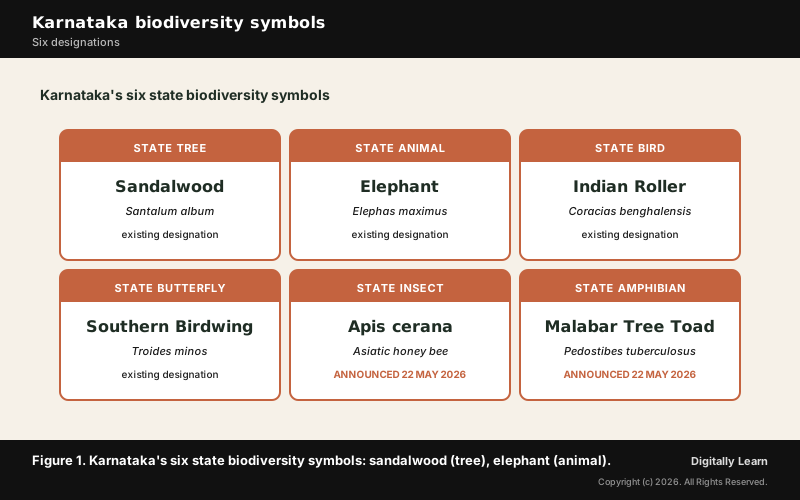
Karnataka already carries four other state biodiversity symbols rooted in its longer conservation policy history across recent decades. The State tree is sandalwood, the State animal the Indian elephant, the State bird the Indian Roller, and the State butterfly the Southern Birdwing endemic to the Western Ghats. The new declarations extend the symbol suite to six designations, signalling an institutional emphasis on invertebrate pollinator conservation and endemic amphibian recognition alongside the existing charismatic megafauna.
Definition: A State Biodiversity Symbol is an administrative designation by a State Government to recognise a species, ecosystem, or natural feature as emblematic of the State's natural heritage. The designation carries no automatic statutory protection under the Wildlife (Protection) Act, 1972, but signals policy priority across departments and supports biodiversity-awareness initiatives in education, tourism, and habitat management. Apis cerana is the Asiatic honey bee, a native pollinator species of South and Southeast Asia and a flagship for the genus Apis in Indian apicultural traditions. The Malabar Tree Toad is an arboreal toad endemic to the Western Ghats and one of very few toad species worldwide that has adapted to tree-canopy life.
Why the symbol declarations matter for biodiversity policy
Pollinator policy and endemic-species recognition
Why it matters: The selection of Apis cerana, rather than the European honey bee Apis mellifera, signals a deliberate policy preference for native pollinator conservation across Karnataka's agricultural and forested landscapes. Apis cerana pollinates a wide range of Western Ghats flora, including the mass-flowering Neelakurinji at higher elevations where Apis mellifera is poorly adapted to the climatic regime. Native bee populations face sustained habitat-loss pressure from land-use change and pesticide-load pressure from intensive cultivation systems across much of India.
The Malabar Tree Toad represents the kind of Western Ghats endemism that distinguishes peninsular Indian amphibian diversity from the rest of the Indian subcontinent. The species is one of the few arboreal toads in the world and a flagship for the broader amphibian-conservation agenda across the Ghats. India hosts more than four hundred amphibian species in total, with a large fraction endemic to the Western Ghats and increasingly stressed by climate variability and habitat fragmentation pressures.
Significance for the conservation framework
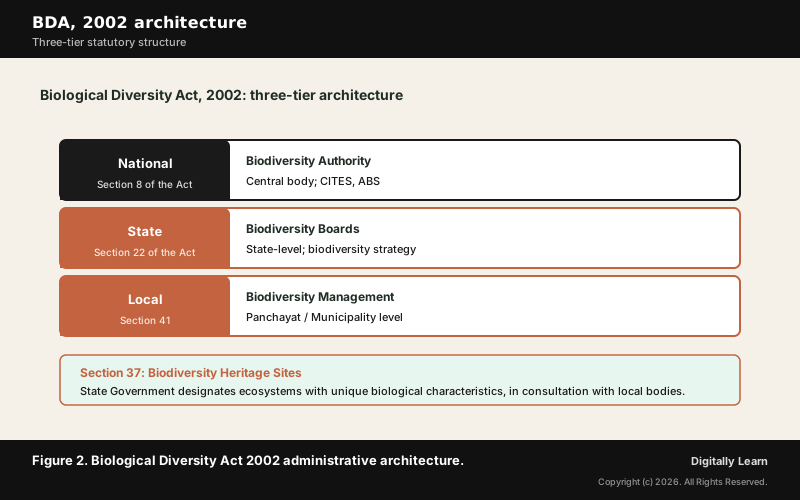
What is the significance of this issue: The declarations engage three strands of India's biodiversity policy framework in a coordinated state-level intervention. The first strand is the Biological Diversity Act, 2002, which provides the statutory base for biodiversity conservation, sustainable use, and equitable benefit-sharing across the country. The second is the State Biodiversity Board structure under Section 22 of the same Act, which administers state-level biodiversity policy through scientific advisory and recommendation functions. The third is the Biodiversity Heritage Site designation under Section 37, used by State Governments to protect sites of unique biological importance with the formal involvement of local communities.
The announcement also named four new Biodiversity Heritage Sites in Karnataka, substantially expanding the network of state-recognised biological-importance zones across diverse agro-ecological landscapes. The four sites are Nallur Tamarind Grove near Devanahalli, the Hogrekan shola-forest corridor in Chikkamagaluru district, Ambaragudda in Sagar taluk of Shivamogga district, and the Mamadapur reserve forest in Vijayapura district. As reported in the same news source, the State has cleared roughly twelve thousand acres of encroached forest land over the past three years and is now restoring elephant and tiger corridors to address the increasing incidence of human-animal conflict across rural Karnataka.
What the two species bring to the symbol register
What makes the Karnataka state-symbol announcement distinctive
Distinguishing features: Three structural features distinguish the new state symbols from the existing four designations and reveal the policy direction Karnataka is signalling on contemporary biodiversity priorities.
- (i) Apis cerana is the first invertebrate pollinator in the Karnataka symbol set, complementing the Southern Birdwing as the State Butterfly and recognising the ecosystem service of native bee pollination across agriculture and wild plant communities.
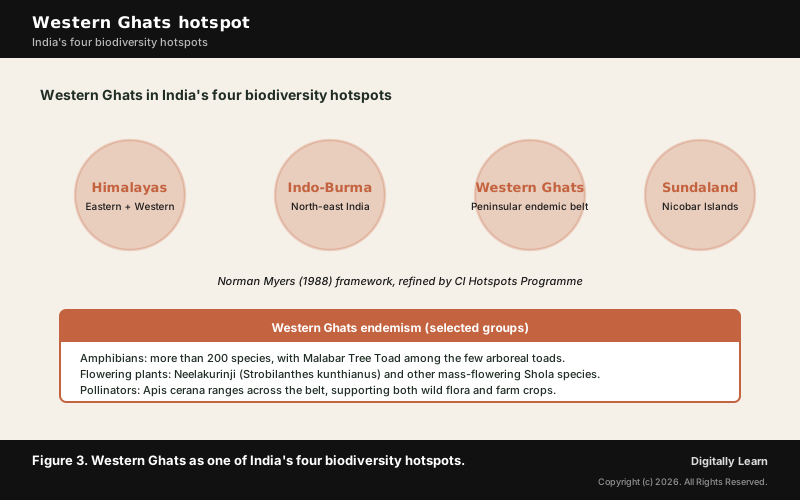
- (ii) The Malabar Tree Toad is the first amphibian in the symbol set and the first Western-Ghats-endemic species at the order-level, flagging the global importance of the Western Ghats as a biodiversity hotspot under the Norman Myers (1988) framework.
- (iii) The pairing combines a pollinator (Apis cerana, an ecosystem-service provider) with an endemic amphibian (Malabar Tree Toad, an indicator species), reflecting both functional and biogeographic priorities in modern conservation theory.
| Biological attribute | Apis cerana (State Insect) | Malabar Tree Toad (State Amphibian) |
|---|---|---|
| Taxonomic group | Order Hymenoptera, Family Apidae | Order Anura, Family Bufonidae |
| Habitat | South and Southeast Asia, mid-elevation forests, agricultural landscapes | Western Ghats endemic, evergreen and semi-evergreen forests |
| Ecological role | Native pollinator of crops and Western Ghats flora | Indicator species; arboreal habit unusual among toads |
| Conservation concern | Habitat loss, pesticides, competition from Apis mellifera | Habitat fragmentation, climate stress on Western Ghats endemics |
Concept link for UPSC examination preparation
Concept link: The announcement connects to UPSC examination preparation through General Studies Paper III (Environment, Conservation, Biodiversity) and General Studies Paper I (Geography of biodiversity hotspots and ecological regions). Aspirants preparing the topic should note the Biological Diversity Act, 2002 with its Section 22 State Biodiversity Board structure and Section 37 Biodiversity Heritage Sites provision, the four Indian biodiversity hotspots (Himalayas, Indo-Burma, Western Ghats, Sundaland), the Convention on Biological Diversity, 1992 along with the Nagoya Protocol, 2010 on access and benefit-sharing, and the ecological distinction between native Apis cerana and the introduced Apis mellifera in Indian apicultural systems and crop-pollination services.
What the declarations could change
Observable outcomes if the declarations are formalised
Observable outcomes: Three concrete shifts could follow the formal notification of the symbols and the four new Biodiversity Heritage Sites over the next several conservation policy cycles and budget rounds.
- (a) Curriculum, awareness materials, and tourism literature in Karnataka begin reflecting Apis cerana and the Malabar Tree Toad as state-symbol species, raising public recognition of native pollinators and endemic amphibians.
- (b) Policy attention on pesticide regulation and on the native-versus-imported honey bee debate sharpens, with the State Biodiversity Board well placed to commission studies on Apis cerana population trends and pollinator services to Karnataka agriculture.
- (c) The new Biodiversity Heritage Site declarations bring four landscapes under enhanced protection under Section 37 of the Biological Diversity Act, with downstream land-use implications for neighbouring habitations and project clearances.
How the four new Karnataka Biodiversity Heritage Sites function
Biodiversity Heritage Sites are notified under Section 37 of the Biological Diversity Act, 2002, which empowers State Governments to designate ecologically significant landscapes through a structured consultation process. The Section enables a State Government, in consultation with local bodies and community institutions, to designate ecosystems and sites with unique biological characteristics as Biodiversity Heritage Sites for coordinated management. The four newly notified Karnataka sites are Nallur Tamarind Grove near Devanahalli, the Hogrekan shola-forest corridor in Chikkamagaluru district, Ambaragudda in Sagar taluk of Shivamogga district, and the Mamadapur reserve forest in Vijayapura district.
Notification under Section 37 does not impose automatic prohibitions on land use within or around the designated landscapes following gazette publication. The designation instead enables coordinated management plans, community-led conservation through Biodiversity Management Committees at the local body level, and structured access to central conservation funding for habitat work. The statutory provision is therefore designed to balance ecological protection with the livelihoods of communities adjacent to or dependent upon the sites for traditional resource use and cultural practice.
Contemporary linkages
The declarations within India's biodiversity policy trajectory
Contemporary linkages: The Karnataka declarations sit within a broader Indian biodiversity policy sequence that connects domestic legislation with international conservation commitments under multiple treaty regimes. The Convention on Biological Diversity, signed at the 1992 Rio Earth Summit, is the foundational international framework for biodiversity governance globally. The Biological Diversity Act, 2002 implements the Convention domestically through a three-tier institutional structure across central, state, and local levels. The Biological Diversity (Amendment) Act, 2023 further streamlined approval procedures for codified traditional knowledge and revised the benefit-sharing rules for digital sequence information.
Three contemporary considerations frame the announcement and connect Karnataka's state-level action to broader global biodiversity policy trends. First, native pollinator decline is a global concern documented systematically by the IPBES Pollinator Assessment of 2016, and the Apis cerana recognition aligns Karnataka with that international policy trajectory on pollinator protection. Second, Western Ghats amphibian endemism has been refined substantially by molecular phylogenetic work over the last two decades, surfacing many more endemic species than herpetologists previously catalogued across the southern Ghats. Third, the Biodiversity Heritage Site mechanism complements the Wildlife (Protection) Act, 1972 protected-area network by adding a category of community-conserved sites that operate outside the formal National Park and Wildlife Sanctuary system across India.
Sources and Further Reading
- Apis cerana and Malabar Tree Toad to be declared State insect and amphibian
- Biological Diversity Act, 2002
- Biological Diversity (Amendment) Act, 2023
- Convention on Biological Diversity, 1992
- Nagoya Protocol on Access and Benefit-Sharing, 2010
- IPBES Global Assessment of Pollinators, 2016
- Norman Myers, Biodiversity Hotspots concept (1988)
- Wildlife (Protection) Act, 1972
Editorial Disclaimer
The Karnataka announcement is a single-source CA event covered by The Hindu Environment beat. Body claims about Minister Eshwar Khandre's statement and the four new Biodiversity Heritage Sites reproduce that reporting. Readers preparing for the UPSC examination should consult the principal notification text under Section 37 of the Biological Diversity Act, 2002 once gazetted.


