


Overview
First NGOPV at GRSE
GRSE Kolkata launched the Indian Navy's first Next-Generation Offshore Patrol Vessel on 20 May 2026.
A Next-Generation Offshore Patrol Vessel (NGOPV) is a class of Indian Navy warship designed for extended-range maritime surveillance, coastal-and-littoral defence, anti-piracy operations, search-and-rescue, and humanitarian-assistance and disaster-relief (HADR) roles. INS Sanghmitra is the first of four NGOPVs being built by the Garden Reach Shipbuilders and Engineers (GRSE), a Defence Public Sector Undertaking under the Ministry of Defence, within an eleven-vessel programme shared with Goa Shipyard Limited. The launch took place at GRSE Kolkata on 20 May 2026.
Why this is in the news on 22 May 2026
The GRSE Kolkata launch and the Atmanirbhar Bharat link
On 20 May 2026, the Garden Reach Shipbuilders and Engineers (GRSE) launched INS Sanghmitra, the first of four Next-Generation Offshore Patrol Vessels (NGOPVs) it is building, at the company's Kolkata shipyard for the Indian Navy. The vessel, designated Yard 3039, is named after Sanghmitra, the daughter of Emperor Ashoka who carried Buddhism to Sri Lanka. It is GRSE's first water-entry milestone in the NGOPV programme.
Definition: An NGOPV is a class of medium-displacement warship optimised for extended-range surveillance, coastal-and-littoral defence, anti-piracy patrols, search-and-rescue, and HADR roles. The class fills the operational gap between the Indian Navy's frontline destroyers and frigates on one side and the smaller fast attack craft on the other.
Three headline outcomes define the launch:
- (i) Indigenisation milestone. The NGOPV programme operates under the Atmanirbhar Bharat framework and the Make in India Defence push, ordered under the Buy Indian-IDDM (Indigenously Designed, Developed and Manufactured) category. GRSE is the designer-builder for its share; the design and manufacturing chain rely on Indian defence-industrial supply.
- (ii) Programme scale. The eleven-vessel NGOPV contract was signed on 30 March 2023 for about 9,781 crore rupees, with seven vessels to Goa Shipyard Limited and four to GRSE. INS Sanghmitra is GRSE’s first hull; the remaining three GRSE vessels are at various stages of construction at the Kolkata yard and the Diamond Harbour facility.
- (iii) Operational role. The class will operate across the Indian Ocean Region (IOR) on extended-range patrols, complementing the Coast Guard’s coastal-defence role and freeing frontline combatants for higher-end missions.
Why the NGOPV launch matters for Indian Navy capability
Naval-shipbuilding indigenisation and IOR maritime presence
Why it matters: The NGOPV launch matters because India's Indian Ocean Region footprint extends from the Persian Gulf in the west to the Malacca Strait in the east, covering a near-7,500-kilometre coastline and an exclusive economic zone of 2.37 million square kilometres. Sustained presence at this scale requires a class of patrol vessels with long endurance and lower cost than frontline destroyers.
The launch also matters because GRSE is a flagship Defence Public Sector Undertaking (DPSU) under the Ministry of Defence. A successful NGOPV delivery cycle strengthens the indigenisation claim, builds export-credentials, and feeds the broader Make in India Defence performance metric tracked by the Department of Defence Production.
Significance for India's maritime-security and DPSU strategy
What the NGOPV launch signals for India's maritime-security and DPSU strategy
What is the significance of this issue: The NGOPV launch carries three significances for India's maritime-security and defence-industrial strategy:
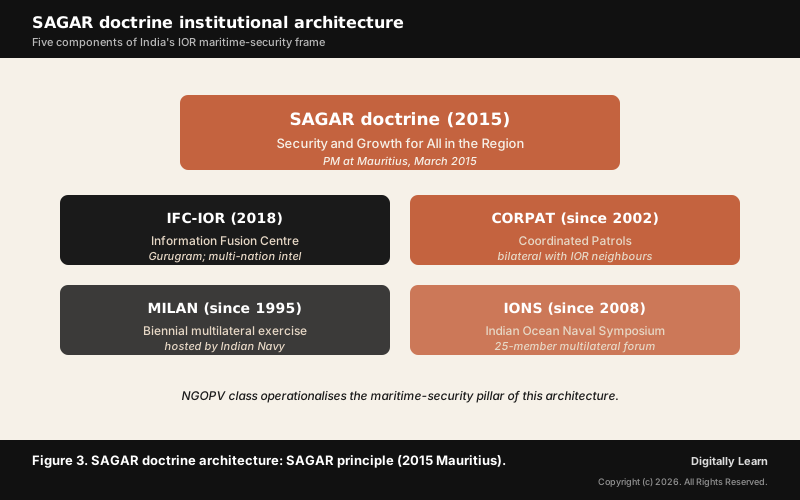
- (i) Maritime-security signal. The Indian Ocean Region carries approximately 50 per cent of global container traffic and 70 per cent of seaborne oil. NGOPV deployment strengthens India’s SAGAR (Security and Growth for All in the Region) doctrine and supports the Information Fusion Centre – Indian Ocean Region (IFC-IOR) intelligence-sharing architecture at Gurugram.
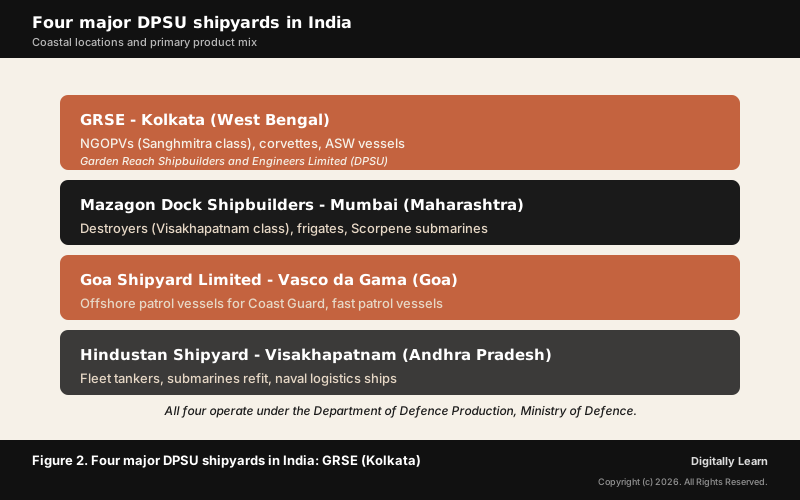
- (ii) DPSU-shipbuilding signal. India operates four major shipyards under the Ministry of Defence: GRSE (Kolkata), Mazagon Dock Shipbuilders (Mumbai), Goa Shipyard Limited (Vasco), and Hindustan Shipyard (Visakhapatnam). The Sanghmitra launch keeps GRSE order-book diversified across destroyer-frigate-corvette and offshore-patrol categories.
- (iii) Make-in-India-Defence signal. The Department of Defence Production tracks indigenisation through the Domestic Defence Production turnover, which crossed 1.27 lakh crore rupees in financial year 2023-24. The NGOPV programme contributes to the trajectory and to the export pipeline.
Distinguishing features of the NGOPV class
The three operational and design pillars of the NGOPV class
Distinguishing features: Three operational and design pillars define the NGOPV class:
- (i) Multi-role mission set. Designed for maritime surveillance, coastal-and-littoral defence, anti-piracy, search-and-rescue (SAR), and HADR. The mission set bridges the operational gap between higher-end destroyers and smaller fast attack craft.
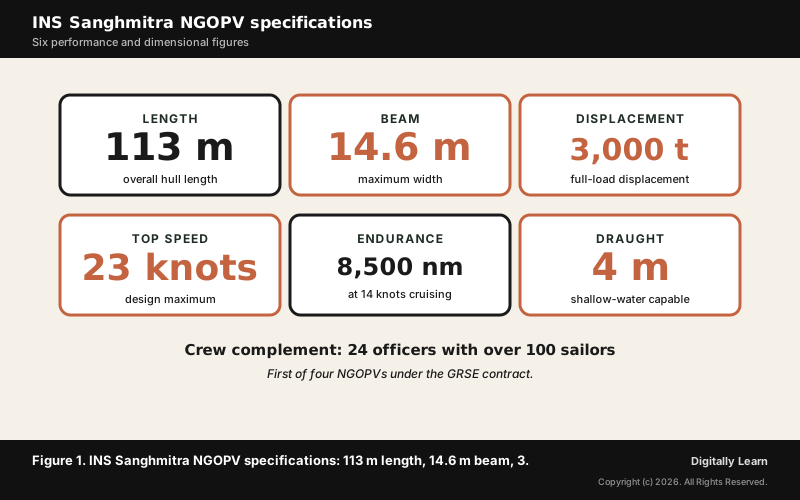
- (ii) Hull and propulsion. 113-metre hull length and 14.6-metre beam, 3,000-tonne displacement. Top speed 23 knots with endurance of 8,500 nautical miles at 14-knot cruise. Four-metre draught supports operations in shallow coastal and estuarine waters.
- (iii) Sensor and weapon fit. Modular sensor and weapon-fit architecture with a main gun, close-in weapon system, secondary guns, and an integrated bridge-and-combat-management system. The platform supports a helicopter pad and a stern-launched rigid-hulled inflatable boat (RHIB) for boarding parties.
INS Sanghmitra specifications and programme details
| Vessel or programme attribute | Detail | Significance |
|---|---|---|
| Class | Next-Generation Offshore Patrol Vessel (NGOPV) | New medium-displacement patrol class for the Indian Navy |
| Lead vessel | INS Sanghmitra (NGOPV-01) | Launched 20 May 2026 at GRSE Kolkata |
| Programme scale | Eleven NGOPVs total: seven at Goa Shipyard, four at GRSE | INS Sanghmitra is GRSE's first hull |
| Operator | Indian Navy | Class fills the destroyer-to-FAC operational gap |
| Builder | Garden Reach Shipbuilders and Engineers (GRSE) | DPSU under Ministry of Defence |
| Length and beam | 113 m by 14.6 m | Medium-displacement OPV class |
| Displacement and draught | 3,000 tonnes; 4-metre draught | Shallow-water-capable |
| Speed and endurance | 23 knots top; 8,500 nm at 14 knots | Extended-range patrols |
| Crew complement | 24 officers with over 100 sailors | Mid-size complement |
| Strategic framework | Atmanirbhar Bharat and Make in India Defence | Indigenous design-and-build chain |
Observable outcomes to track through the NGOPV programme
What to watch from launch through fleet operational status
Observable outcomes: Five outcomes frame the NGOPV programme trajectory from May 2026 to fleet operational status:
- (a) Sea trials. Whether INS Sanghmitra completes harbour-acceptance trials and sea-acceptance trials on schedule, in the 18-24-month window typical for an OPV class.
- (b) Commissioning. Formal commissioning into the Indian Navy fleet with the prefix INS retained; expected in the 2027-2028 window.
- (c) Remaining three NGOPV hulls. Construction milestones for NGOPV-02, NGOPV-03, NGOPV-04 at GRSE Kolkata and Diamond Harbour facilities; rolling-launch cadence at one hull per 9-12 months.
- (d) Indigenisation content. Department of Defence Production tracks the indigenous-content percentage; the NGOPV class is expected to exceed 70 per cent indigenous content by value.
- (e) Export pipeline. GRSE export interest from partner navies (Mauritius, Sri Lanka, Bangladesh, Indonesia, ASEAN) for similar OPV classes; the Sanghmitra launch is a credentialing event for the export-marketing cycle.
Threads connecting Sanghmitra to wider defence-and-maritime policy
How the NGOPV launch connects to SAGAR, DPSU shipbuilding, and the Atmanirbhar Bharat Defence push
Contemporary linkages: Three threads connect the INS Sanghmitra launch to wider defence-and-maritime policy.
The first is the SAGAR-doctrine thread. SAGAR (Security and Growth for All in the Region), announced by the Prime Minister at Mauritius in March 2015, is India's Indian Ocean Region engagement framework. NGOPV class deployments support the maritime-security pillar of SAGAR alongside Information Fusion Centre – IOR (IFC-IOR) intelligence-sharing and bilateral Coordinated Patrols (CORPAT).
The second is the DPSU-shipbuilding thread. The four DPSU shipyards (GRSE, Mazagon Dock Shipbuilders, Goa Shipyard Limited, Hindustan Shipyard) form the indigenous naval-shipbuilding base. The Defence Acquisition Procedure 2020 and the Strategic Partnership Model (May 2017) govern private-sector participation alongside DPSU primes.
The third is the Atmanirbhar-Bharat-Defence thread. The Department of Defence Production tracks the Domestic Defence Production turnover (1.27 lakh crore rupees in 2023-24) and the positive indigenisation lists (five lists published 2020-2023 banning import of specified items beyond a phase-out date). The NGOPV programme contributes to the turnover metric and operationalises the indigenisation-list discipline.
UPSC Relevance
Where the launch sits in the UPSC syllabus
UPSC context: The INS Sanghmitra launch falls within General Studies Paper III under various security forces and agencies and their mandate, border-management challenges (maritime border), and linkages of organized crime with terrorism (anti-piracy and trafficking interdiction). The shipbuilding-and-DPSU dimension also touches development of new technology, indigenisation of technology and developing new technology.
Prelims relevance: The Prelims surface includes NGOPV class specifications (length 113 m, displacement 3,000 tonnes, speed 23 knots, endurance 8,500 nm), the four DPSU shipyards (GRSE, Mazagon Dock Shipbuilders, Goa Shipyard Limited, Hindustan Shipyard), the SAGAR doctrine (2015 Mauritius), IFC-IOR (2018 Gurugram), CORPAT, MILAN, IONS, the Defence Acquisition Procedure 2020, the Strategic Partnership Model of May 2017, and the positive indigenisation lists for defence equipment.
Mains relevance: Two framings dominate the Mains-paper surface:
- (i) Maritime-security-challenges framing. What maritime-security challenges India faces and what organisational, technical, and procedural initiatives have been taken. The NGOPV launch is the latest technical-initiative evidence, alongside SAGAR doctrine, IFC-IOR, CORPAT, and the National Maritime Security Coordinator architecture.
- (ii) Defence-FDI-liberalisation framing. The influence of liberalised FDI in the defence sector on Indian defence and economy. The DPSU shipbuilding programme (GRSE NGOPV, Mazagon submarines, Goa Shipyard OPVs) is the indigenous-track complement to private-sector and FDI-led capacity.
Mains practice question: A focused fifteen-mark question would read: The launch of INS Sanghmitra at GRSE Kolkata on 20 May 2026 is the first hull-launch of the Next-Generation Offshore Patrol Vessel class. Examine the role of NGOPV-class vessels in India's maritime-security architecture and discuss the contribution of DPSU shipyards to the Atmanirbhar Bharat Defence agenda.
- Past Mains linkage. 2022 GS-III: What are the maritime security challenges in India? Discuss the organisational, technical and procedural initiatives taken to improve the maritime security. The NGOPV class is the latest technical initiative; INS Sanghmitra is the headline evidence for the answer.
- Past Mains linkage. 2014 GS-III: Foreign Direct Investment (FDI) in the defence sector is now set to be liberalized. What influence this is expected to have on Indian defence and economy in the short and long run? The DPSU-NGOPV programme is the indigenous-track baseline against which FDI-led capacity adds capability.
- Related Prelims linkage. Prelims questions on the SAGAR doctrine, IFC-IOR, and DPSU shipyards test the institutional surface that the Sanghmitra launch sits within.
Previous Year UPSC-CSE Questions By the end you will be able to draft model answers for the following UPSC questions. Each question carries a collapsible framework showing how to approach it in the exam.
- UPSC Mains 2022 GS-IIIWhat are the maritime security challenges in India? Discuss the organisational, technical and procedural initiatives taken to improve the maritime security.
How to structure the answer in the exam
Introduction: Open with India's 7,500-km coastline and 2.37-million-sq-km EEZ, name SAGAR (2015 Mauritius) as the doctrinal frame, and structure the answer through five challenges and three initiative buckets.
Body (sub-themes to develop):
- Five challenges: piracy off Gulf of Aden and Somali coast; arms-and-drug trafficking via maritime routes; illegal-unreported-unregulated (IUU) fishing in the EEZ; maritime terrorism (post-26/11 Mumbai attacks 2008); marine-environmental incidents (oil spills, container losses).
- Organisational initiatives: National Maritime Security Coordinator (NMSC) office created 2022; Joint Operations Centre at Mumbai; Coastal Security Scheme expanded post-2008; Marine Police framework under State Governments; Coast Guard expansion.
- Technical initiatives: Information Fusion Centre – IOR (IFC-IOR) at Gurugram (2018); Coastal Surveillance Network (CSN) of radar stations under Coast Guard; INS Sanghmitra NGOPV launch (20 May 2026) as the latest hull-class addition; the four-NGOPV programme at GRSE Kolkata.
- Procedural initiatives: Coordinated Patrols (CORPAT) with Indonesia, Thailand, Bangladesh, Myanmar; MILAN biennial multilateral exercise (since 1995); IONS Indian Ocean Naval Symposium (since 2008); Maritime Security Dialogues bilaterally.
- Atmanirbhar layer: DPSU shipbuilding base (GRSE, Mazagon Dock, Goa Shipyard, Hindustan Shipyard); positive indigenisation lists 2020-2023; Defence Acquisition Procedure 2020 with Buy-Indian-IDDM categorisation.
Conclusion: Conclude that India's maritime-security challenges span five categories, that the response runs through three initiative buckets (organisational, technical, procedural), and that the INS Sanghmitra NGOPV launch of May 2026 is the latest technical-initiative evidence reinforcing the SAGAR doctrine.
The INS Sanghmitra NGOPV launch of 20 May 2026 is the most-current technical-initiative evidence the 2022 GS-III question asks for. The body sub-theme on technical initiatives supplies the leading 2026-current pillar.
- UPSC Mains 2014 GS-IIIForeign Direct Investment (FDI) in the defence sector is now set to be liberalized. What influence this is expected to have on Indian defence and economy in the short and long run?
How to structure the answer in the exam
Introduction: Open with the 2014 raising of automatic-route FDI from 26 per cent to 49 per cent and the 2020 raise to 74 per cent automatic, frame the answer through short-run and long-run influence buckets.
Body (sub-themes to develop):
- Short-run: joint ventures between Indian primes (DPSUs and private-sector L&T, Tata, M&M Defence) and global OEMs; technology transfer on sub-systems and components; offset-clause investments under DAP-2020.
- Short-run: easing of supply-chain dependence on imports for non-platform items; positive impact on goods-trade balance from reduced import of small-arms, sensors, electronics.
- Long-run: domestic indigenisation capability; cumulative learning effect that lowers per-unit cost; export pipeline through Brahmos missile and Tejas aircraft channels; Domestic Defence Production turnover crossed 1.27 lakh crore rupees in financial year 2023-24.
- Long-run: DPSU complementarity; NGOPV launch (INS Sanghmitra, 20 May 2026) demonstrates DPSU shipbuilding capacity; private-sector and FDI-led capacity adds destroyer-frigate-submarine and aerospace adjacencies rather than substituting for DPSUs.
- Tensions: technology-transfer conditions; intellectual-property rights tussles; strategic-autonomy vs market-access trade-off in choosing Russian, French, US, Israeli, Korean partners.
Conclusion: Conclude that FDI liberalisation in defence raises short-run capacity through joint ventures and technology transfer and long-run capacity through indigenisation and export pipelines, that the DPSU shipbuilding base (NGOPV INS Sanghmitra of May 2026) continues to underpin the indigenous track, and that the policy mix needs both.
The NGOPV INS Sanghmitra launch at GRSE Kolkata is the most-current DPSU-track evidence the 2014 GS-III question's long-run defence-and-economy assessment must include. The body sub-theme on long-run DPSU complementarity supplies the 2026 evidence point.
Sources
- GRSE corporate release: NGOPV INS Sanghmitra launch
- Indian Navy press release on NGOPV launch
- Ministry of Defence: Department of Defence Production materials
- Press Information Bureau release on DPSU shipyards and Atmanirbhar Bharat Defence
- Ministry of External Affairs: SAGAR doctrine briefings
- Indian Navy: Information Fusion Centre – IOR institutional materials
- Defence Acquisition Procedure 2020 (DAP-2020)
- Wikipedia: GRSE / Indian Navy / NGOPV
Editorial Disclaimer
This article is compiled from the reference materials listed in the Sources section. It is an explainer for UPSC preparation and is not a substitute for primary documents (NCERTs, GoI ministry releases, IMD bulletins, RBI / CEA / MoEFCC publications, and Standing-Committee reports).


