


Overview
INS Aridhaman is the third nuclear-powered ballistic missile submarine of the Indian Navy's Arihant class. A submarine of this type, known as an SSBN, runs on a nuclear reactor and carries ballistic missiles, letting it stay hidden underwater for long periods. It was commissioned on 3 April 2026 by the Defence Minister at Visakhapatnam, and was built at home under the Advanced Technology Vessel project. It strengthens the sea-based leg of India's nuclear triad, the part of the deterrent that is hardest for an adversary to find and destroy.
Why INS Aridhaman is in focus
A third strategic submarine joins the fleet
The Indian Navy commissioned INS Aridhaman on 3 April 2026, in the presence of the Defence Minister, at Visakhapatnam. It is India's third nuclear-powered ballistic missile submarine.
A nuclear-powered ballistic missile submarine, or SSBN, is powered by a nuclear reactor and armed with ballistic missiles. Because it can stay submerged and hidden for long stretches, it is hard to track.
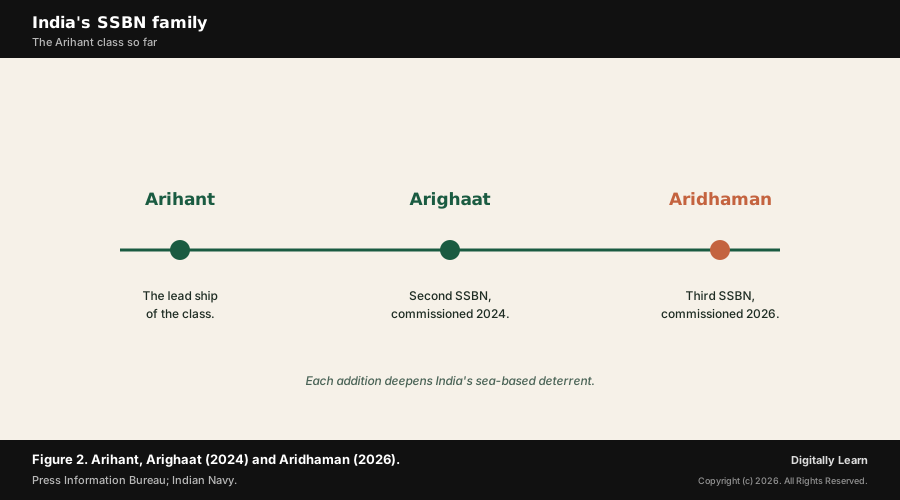
Aridhaman joins INS Arihant and INS Arighaat in the Arihant class. It was built at home under the Advanced Technology Vessel project, a marker of indigenous strategic capability.
The key elements of the development are:
- Commissioned: inducted on 3 April 2026 at Visakhapatnam.
- Type: India’s third nuclear-powered ballistic missile submarine.
- Class: the Arihant class, after Arihant and Arighaat.
- Build: indigenous, under the Advanced Technology Vessel project.
Why the commissioning matters
Completing a survivable deterrent
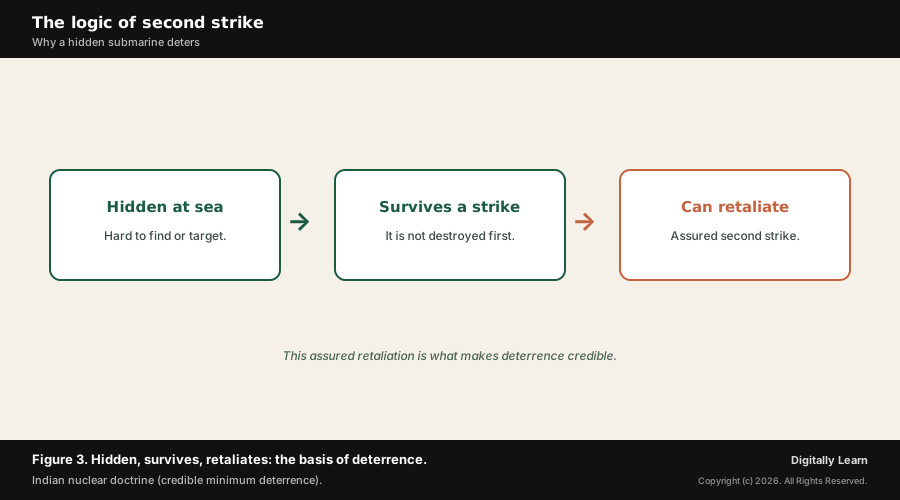
A nuclear deterrent is credible only if it can survive a first strike and retaliate. A submarine, hidden at sea, is the platform an adversary can least easily destroy, so it anchors that assurance.
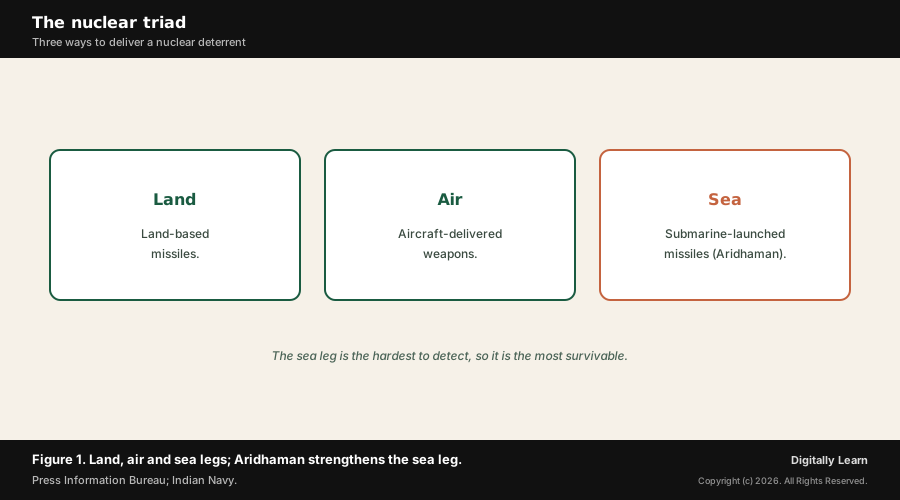
India's nuclear triad has land, air and sea legs. Each new SSBN deepens the sea-based component, allowing more continuous patrols and a more reliable second-strike posture.
It also signals indigenous capability. Building a strategic submarine at home, under the Advanced Technology Vessel project, places India among the few countries that design and operate their own SSBNs.
What the commissioning signifies
Second strike, continuous patrols, and self-reliance
What is the significance of this commissioning. Three threads carry the weight: assured second strike, the move towards continuous patrols, and self-reliance in strategic platforms.
First, assured second strike. India's stated nuclear doctrine rests on no first use and credible minimum deterrence, both of which depend on the ability to retaliate even after absorbing a strike.
Second, continuous patrols. A larger SSBN fleet lets the Navy keep at least one boat on deterrent patrol at all times, which makes the sea-based deterrent dependable rather than occasional.
Third, self-reliance. Designing and building such a submarine at home reduces dependence on foreign suppliers for the most sensitive strategic technology.
Distinguishing features of the programme
The commissioning at a glance
The table sets out the key facts, so the identity and role of the submarine are visible at a glance.
| Feature | Detail |
|---|---|
| Vessel | INS Aridhaman |
| Type | Nuclear-powered ballistic missile submarine (SSBN) |
| Sequence | India's third SSBN, after Arihant and Arighaat |
| Commissioned | 3 April 2026, Visakhapatnam |
| Built under | Advanced Technology Vessel project (indigenous) |
Three features that define an SSBN
Three traits make an SSBN central to deterrence:
- (i) Nuclear propulsion. A reactor lets it stay submerged for very long periods without surfacing for fuel.
- (ii) Ballistic missiles. It carries submarine-launched ballistic missiles for long-range strike.
- (iii) Survivability. Hidden underwater, it is the platform an adversary can least easily target.
Observable outcomes
Three trackable outcomes
The commissioning translates into three developments to watch in the strategic domain.
- (a) Deeper patrols. A third boat moves the Navy closer to keeping a submarine on deterrent patrol at all times.
- (b) More indigenous build. The programme is expected to continue with further, more capable boats over time.
- (c) Stronger sea denial. A larger nuclear-submarine arm supports India’s wider maritime and strategic posture.
A commissioned boat is the start, not the finish. Sustained patrols, crews and maintenance decide whether the deterrent is truly continuous.
Doctrine, the triad and self-reliance
No first use, the triad and indigenous defence
The submarine serves India's stated nuclear doctrine of no first use and credible minimum deterrence, which relies on a guaranteed ability to strike back.
It completes the picture of the nuclear triad, the land, air and sea means of delivery, with the sea leg being the most survivable and therefore the most stabilising.
It also advances self-reliance in defence, since the Advanced Technology Vessel project shows India designing and building its most sensitive strategic systems at home.
UPSC relevance and exam focus
Where this fits in the UPSC-CSE syllabus
This topic maps to General Studies Paper III: science and technology, defence, and security, with links to indigenisation and India's strategic posture.
For Prelims, hold the high-yield facts: what an SSBN is, the Arihant class and its boats, the meaning of the nuclear triad, and the Advanced Technology Vessel project.
For Mains, two framings recur: indigenisation and self-reliance in defence, and the credibility of India's nuclear deterrence.
Recurring linked concepts an aspirant should keep in working memory:
- SSBN: a nuclear-powered ballistic missile submarine.
- Nuclear triad: land, air and sea means of delivery.
- No first use: a pillar of India’s stated nuclear doctrine.
- Advanced Technology Vessel: the indigenous nuclear-submarine project.
An SSBN (ballistic missile submarine) is different from an SSN (an attack submarine without strategic missiles). Confusing the two is a frequent error.
Do not treat the submarine as just a platform. Its value lies in the survivable, assured second strike it gives the deterrent.
Previous Year UPSC-CSE Questions By the end you will be able to draft model answers for the following UPSC questions. Each question carries a collapsible framework showing how to approach it in the exam.
- UPSC Mains 2014 GS-IIIForeign Direct Investment (FDI) in the defence sector is now set to be liberalized: What influence is this expected to have on Indian defence and economy in the short and long-run?
How to structure the answer in the exam
Introduction: Open with the goal of a stronger, more self-reliant defence base.
Body (sub-themes to develop):
- Short run: capital, technology and jobs from investment.
- Long run: indigenisation, exports and reduced import dependence.
- Risks: control of sensitive technology and strategic autonomy.
- Indigenous strategic builds such as the Advanced Technology Vessel project.
- Balancing openness with security.
Conclusion: Conclude that calibrated openness plus indigenous capability best serves defence and the economy.
- UPSC Prelims 2023Consider the following statements:
- Ballistic missiles are jet-propelled at subsonic speeds throughout their flights, while cruise missiles are rocket-powered only in the initial phase of flight.
- Agni-V is a medium-range supersonic cruise missile, while BrahMos is a solid-fuelled intercontinental ballistic missile.
Which of the statements given above is/are correct?
How to approach this Prelims question
Approach: Test each statement against how ballistic and cruise missiles actually work.
Trap to watch: Both statements reverse the facts: ballistic missiles are rocket-powered and follow a ballistic arc, cruise missiles are jet-powered; Agni-V is a long-range ballistic missile and BrahMos is a cruise missile, so neither statement is correct.
Key facts to recall:
- Ballistic missiles are rocket-powered and follow a high arc.
- Cruise missiles are jet-powered and fly low like an aircraft.
- Agni-V is a ballistic missile; BrahMos is a cruise missile.
Answer signal: Both statements are wrong. Correct answer: Neither 1 nor 2.
Sources and Further Reading
- Press Information Bureau: INS Arighaat (second Arihant-class submarine) commissioned
- Ministry of Defence: Why the name Arihant was chosen for India's first nuclear-powered submarine
- Indian Navy: Firsts in the Submarine Arm of the Indian Navy
- Press Information Bureau: PM felicitates crew of INS Arihant on completion of the nuclear triad
- Wikipedia: INS Aridhaman
- Wikipedia: Arihant-class submarine
Editorial Disclaimer
This article is compiled from the reference materials listed in the Sources section. It is an explainer for UPSC preparation and is not a substitute for primary documents (NCERTs, GoI ministry releases, IMD bulletins, RBI / CEA / MoEFCC publications, and Standing-Committee reports).


