


Overview
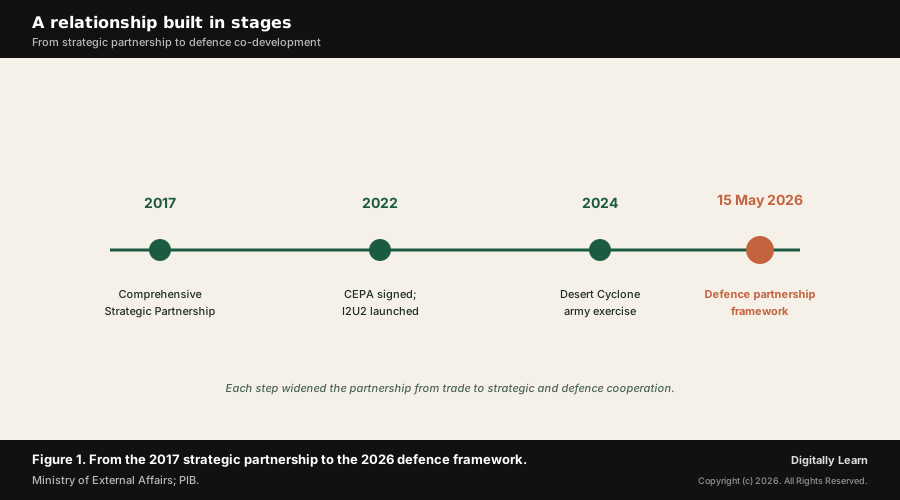
The India-UAE Strategic Defence Partnership is a framework agreed during Prime Minister Modi's visit to Abu Dhabi on 15 May 2026 to deepen defence cooperation between the two countries. It focuses on defence industrial collaboration, joint partnerships, co-development, and innovation and technology sharing. The framework builds on a Comprehensive Strategic Partnership, the 2022 Comprehensive Economic Partnership Agreement (CEPA), and the I2U2 grouping of India, Israel, the UAE and the United States, marking a shift from a buyer-seller relationship towards joint production.
Why the India-UAE defence framework is in focus
A framework for strategic defence cooperation
During Prime Minister Modi's visit to Abu Dhabi on 15 May 2026, India and the United Arab Emirates established a Framework for the Strategic Defence Partnership. It is designed to deepen defence industrial cooperation between the two countries.
A strategic defence partnership is a structured agreement to move beyond arms purchases towards joint partnerships, co-development and shared technology. It treats defence as a domain of industrial collaboration, not only procurement.
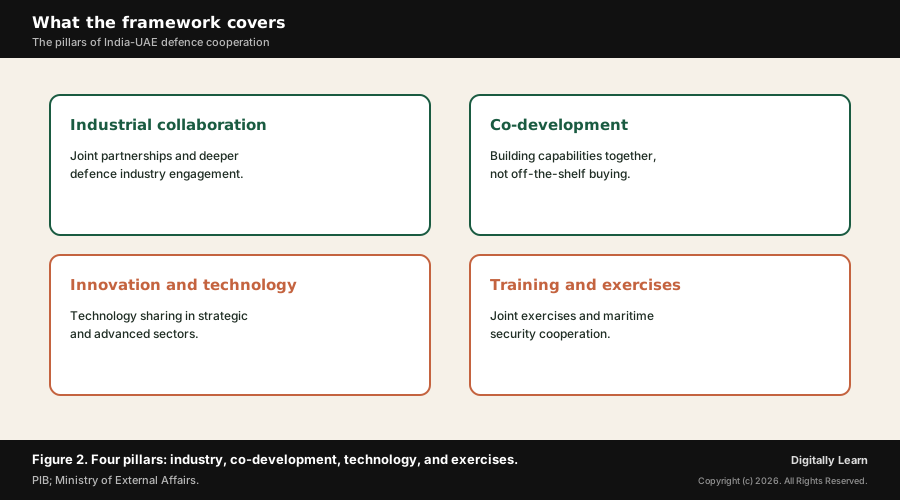
The framework encourages joint partnerships and greater industry engagement, and it promotes innovation and technology sharing in strategic sectors. This supports cooperation in advanced defence manufacturing and capabilities on both sides.
The core elements of the framework are:
- Industrial collaboration: deeper defence industrial cooperation and joint partnerships.
- Co-development: joint development of capabilities rather than off-the-shelf purchases.
- Innovation and technology: technology sharing in strategic and advanced sectors.
- Institutional anchor: the Joint Defence Cooperation Committee as the standing mechanism.
Why the partnership matters
From buyer-seller to co-producer in West Asia
The UAE is among India's most important partners in West Asia, a region central to India's energy supplies, diaspora and trade. A defence framework deepens an already broad relationship.
The shift towards co-development is significant. It signals India's ambition to be a defence co-producer and exporter, not only a buyer, aligning with the wider push for self-reliance in defence manufacturing.
The timing also matters for regional security. As West Asia faces recurring instability, a structured India-UAE partnership adds maritime and security cooperation to a relationship long anchored in energy and commerce.
What the framework signifies
Self-reliance, regional balance and multi-domain ties
Three threads carry the weight: India's defence-manufacturing ambition, the diversification of strategic partners in West Asia, and the breadth of the India-UAE relationship.
First, self-reliance. Co-development with a willing partner advances India's goal of an indigenous defence-industrial base, and opens an export and joint-production route for Indian firms.
Second, regional balance. A deeper defence tie with the UAE diversifies India's West Asia partnerships beyond energy, giving New Delhi more strategic room in a volatile neighbourhood.
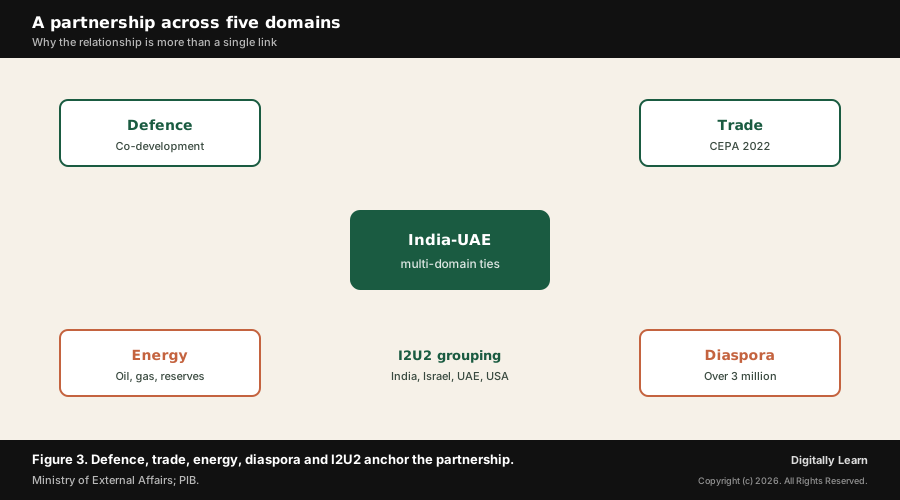
Third, multi-domain depth. Defence now joins trade, energy and people-to-people ties, so the relationship rests on several pillars rather than a single commodity link.
Distinguishing features of the partnership
The India-UAE partnership at a glance
The table places the new defence framework alongside the milestones that built the relationship, so its multi-domain base is visible at a glance.
| Dimension | Milestone or detail |
|---|---|
| Strategic ties | Comprehensive Strategic Partnership (2017) |
| Trade | CEPA signed in 2022, targeting US$100 billion in bilateral trade |
| Plurilateral grouping | I2U2 (India, Israel, UAE, USA) |
| Defence | Strategic Defence Partnership framework (15 May 2026) |
| People-to-people | Over 3 million-strong Indian community in the UAE |
Three features that define the framework
Three elements set this defence framework apart from a routine arms deal:
- (i) Co-development over procurement. The emphasis is on joint partnerships and co-development, not off-the-shelf purchases.
- (ii) Technology and innovation. The framework promotes technology sharing in strategic and advanced manufacturing sectors.
- (iii) Institutional continuity. The Joint Defence Cooperation Committee provides the standing forum that carries the cooperation forward.
Observable outcomes
Three trackable outcomes
The framework translates into three visible developments to watch.
- (a) Joint ventures. Indian and Emirati defence firms can pursue co-development projects under the new framework.
- (b) Deeper exercises. Bilateral exercises such as the army’s Desert Cyclone series can expand in scope and frequency.
- (c) Wider deals. The visit paired defence with energy and investment agreements, signalling a package approach to ties.
A framework sets direction; the test is delivery. Concrete co-production projects and technology transfers will show whether the partnership moves beyond intent.
India-UAE ties in the wider strategic picture
West Asia, energy security and minilateral diplomacy
The framework fits India's broader West Asia engagement, where energy security, trade and a large diaspora make the Gulf central to India's economic interests.
It connects to minilateral diplomacy, especially the I2U2 grouping of India, Israel, the UAE and the United States, which links India to new coalitions on technology, connectivity and security.
The partnership also advances defence self-reliance. By seeking co-production abroad, India tests whether its defence-industrial push can win partners and markets beyond domestic procurement.
UPSC relevance and exam focus
Where this fits in the UPSC-CSE syllabus
This topic maps to General Studies Paper II: bilateral and regional groupings involving India, and agreements affecting India's interests, with links to General Studies Paper III: defence and internal security and the defence-industrial base.
For Prelims, hold the high-yield facts: the I2U2 members, the 2022 CEPA, the Comprehensive Strategic Partnership, the Joint Defence Cooperation Committee, and the date of the defence framework.
For Mains, two framings recur: how India's West Asia partnerships serve energy security and the diaspora, and how defence co-development advances self-reliance and export ambitions.
Recurring linked concepts an aspirant should keep in working memory:
- I2U2: the India, Israel, UAE and United States grouping.
- CEPA: the 2022 Comprehensive Economic Partnership Agreement with the UAE.
- Comprehensive Strategic Partnership: the umbrella framework for India-UAE ties.
- Joint Defence Cooperation Committee: the standing institutional mechanism for defence.
The I2U2 grouping is India, Israel, the UAE and the United States. Substituting any other country, such as Iran or Saudi Arabia, for one of these four is a frequent error.
Do not treat the framework as a finished deal. It is a direction-setting agreement, so a balanced answer separates the stated intent from the delivery that must follow.
Previous Year UPSC-CSE Questions By the end you will be able to draft model answers for the following UPSC questions. Each question carries a collapsible framework showing how to approach it in the exam.
- UPSC Mains 2022 GS-IIHow will I2U2 (India, Israel, UAE and USA) grouping transform India's Position in global politics?
How to structure the answer in the exam
Introduction: Open with I2U2 as a minilateral of India, Israel, the UAE and the USA, linking West Asia to the Indo-Pacific.
Body (sub-themes to develop):
- Economic gains: food security, technology, infrastructure and investment corridors.
- Strategic depth: a stable West Asia partnership complementing India's wider ties.
- Defence and technology: co-development and innovation, reinforced by the 2026 India-UAE defence framework.
- Connectivity: links to corridors such as IMEC and to energy security.
- Limits: balancing competing regional rivalries and avoiding overdependence.
Conclusion: Conclude that I2U2 widens India's strategic options if it converts frameworks into concrete projects.
- UPSC Mains 2017 GS-IIThe question of India's Energy Security constitutes the most important part of India's economic progress. Analyze India's energy policy cooperation with West Asian countries.
How to structure the answer in the exam
Introduction: Open with India's heavy dependence on West Asian crude and gas for its energy needs.
Body (sub-themes to develop):
- Dependence: a large share of India's oil and gas imports comes from West Asia.
- Cooperation: long-term supply deals, strategic petroleum reserves and upstream investment.
- The UAE's role: a key supplier and investor, now also a defence partner.
- Diversification: balancing West Asian supply with other sources to manage risk.
- Vulnerabilities: regional instability and chokepoints affecting supply security.
Conclusion: Conclude that diversified, resilient partnerships in West Asia underpin India's energy security.
Sources and Further Reading
Editorial Disclaimer
This article is compiled from the reference materials listed in the Sources section. It is an explainer for UPSC preparation and is not a substitute for primary documents (NCERTs, GoI ministry releases, IMD bulletins, RBI / CEA / MoEFCC publications, and Standing-Committee reports).


