


Overview
The India-Norway green maritime partnership is the focus of the Joint Statement issued during Prime Minister Modi's visit to Norway on 18 May 2026. It pairs Norway's expertise in clean shipping and ship design with India's shipbuilding scale and shipyard capacity to advance maritime decarbonisation. The two sides agreed to cooperate on green shipping, hydrogen and e-methanol vessels, and green ports, and their science agencies signed a declaration on science, technology and innovation for the green shift. The bilateral runs alongside, but is distinct from, the multilateral India-Nordic Summit held the next day.
Why the India-Norway partnership is in focus
A bilateral visit centred on green shipping
During Prime Minister Modi's visit to Norway on 18 May 2026, India and Norway issued a Joint Statement deepening their partnership, with green maritime cooperation as its centrepiece.
A green maritime partnership focuses on cutting the carbon emissions of shipping. It covers cleaner fuels, efficient ship design, and greener ports, the elements that together decarbonise sea transport.
The visit was a bilateral leg, hosted by the Norwegian Prime Minister. It is distinct from the India-Nordic Summit, the multilateral meeting with the five Nordic states held the following day.
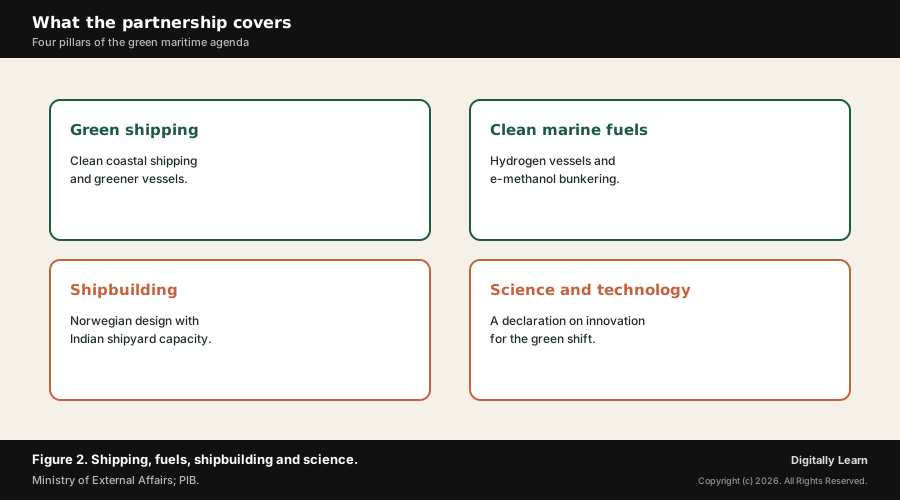
The core elements of the partnership are:
- Green shipping: cooperation on clean coastal shipping and the green transition of vessels.
- Clean fuels: work on hydrogen-powered vessels and e-methanol bunkering.
- Shipbuilding: pairing Norway’s ship design with India’s shipyard capacity.
- Science cooperation: a declaration on science, technology and innovation for the green shift.
Why the partnership matters
Two complementary maritime nations
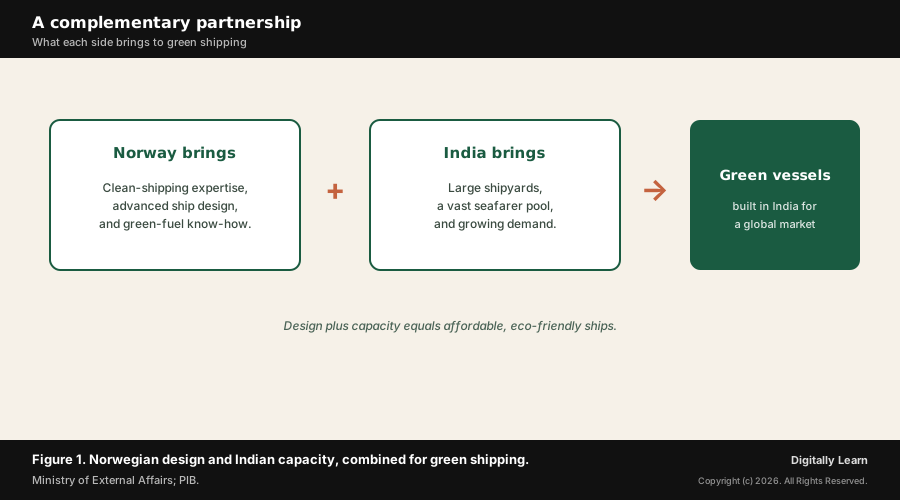
Norway is a global leader in clean shipping and ship design, while India has large shipyards and a vast pool of seafarers. The fit between the two is natural and unusually complementary.
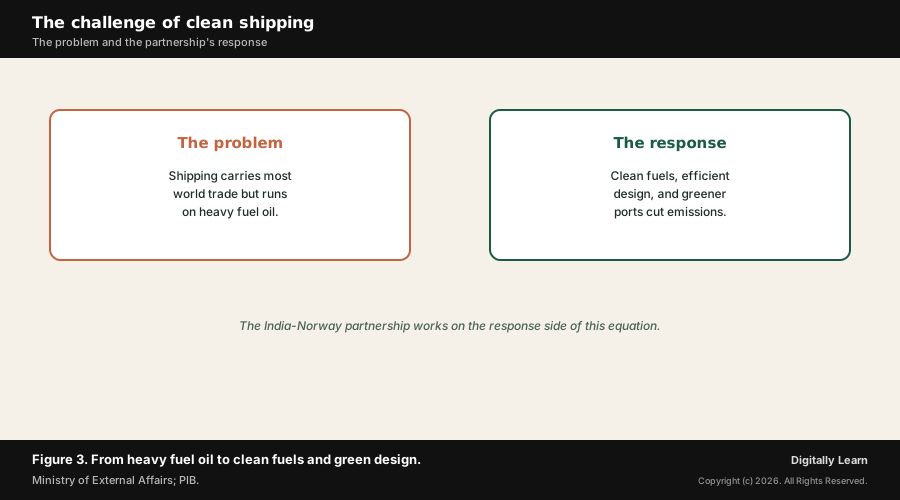
Shipping is hard to decarbonise. It carries most of world trade yet runs largely on heavy fuel oil, so partnerships on hydrogen and e-methanol vessels address one of the toughest gaps in climate action.
For India, the tie supports its blue economy and shipbuilding ambitions. Building world-class green vessels at home could turn India into a hub for an emerging global market.
What the partnership signifies
Decarbonisation, self-reliance and science
Three threads carry the weight: the decarbonisation of shipping, India's shipbuilding self-reliance, and deeper science cooperation.
First, decarbonisation. Working on hydrogen and e-methanol vessels and on green coastal shipping helps cut emissions from a sector that is central to trade yet hard to clean.
Second, self-reliance. Pairing Norwegian design with Indian shipyards advances India's goal of building advanced vessels at home, supporting jobs and the blue economy.
Third, science cooperation. The declaration on science and technology for the green shift links research bodies in both countries on clean energy, ocean science and the circular economy.
Distinguishing features of the partnership
The areas of cooperation
The table sets out the main strands of the partnership, so its green-maritime focus is visible at a glance.
| Area | What it covers |
|---|---|
| Green shipping | Clean coastal shipping and the green transition of vessels |
| Clean fuels | Hydrogen-powered vessels and e-methanol bunkering |
| Shipbuilding | Norwegian ship design with Indian shipyard capacity |
| Science and technology | A declaration on innovation for the green shift |
Three features that define the partnership
Three elements set this partnership apart from a routine bilateral statement:
- (i) A single, sharp focus. The partnership is anchored in green shipping rather than a long, diffuse list of sectors.
- (ii) Complementarity. It builds on a genuine fit between Norwegian design strength and Indian manufacturing scale.
- (iii) Research-backed. Science and technology agencies in both countries signed pacts to underpin the cooperation with research.
Observable outcomes
Three trackable outcomes
The partnership translates into three developments to watch in the coming years.
- (a) Joint vessel projects. Norwegian and Indian firms can pursue co-design and building of green ferries and vessels.
- (b) Cleaner ports and fuels. Pilots on e-methanol bunkering and green ports can take shape at Indian harbours.
- (c) Research outputs. The science declaration can yield joint projects on ocean science, clean energy and the circular economy.
Green shipping depends on the cost of clean fuels. Whether hydrogen and e-methanol become affordable will decide how fast these projects scale.
Green shipping and the wider climate agenda
Maritime decarbonisation, the blue economy and clean-energy diplomacy
The partnership sits inside the global push for maritime decarbonisation, where international rules increasingly require shipping to cut its greenhouse-gas emissions over the coming decades.
It connects to India's blue economy agenda, which seeks to harness ocean resources sustainably, and to its shipbuilding and port-modernisation programmes along the coast.
The tie also advances India's clean-energy diplomacy. Partnering a climate-forward economy like Norway strengthens India's position in international forums on energy transition and green technology.
UPSC relevance and exam focus
Where this fits in the UPSC-CSE syllabus
This topic maps to General Studies Paper II: bilateral agreements involving India, and to General Studies Paper III: environment, the blue economy and clean-energy transition.
For Prelims, hold the high-yield facts: the 18 May 2026 Joint Statement, the green-shipping focus, the clean fuels involved, and the science declaration for the green shift.
For Mains, two framings recur: India's clean-energy and climate diplomacy with partners, and the decarbonisation of shipping within the blue economy.
Recurring linked concepts an aspirant should keep in working memory:
- Maritime decarbonisation: cutting shipping’s greenhouse-gas emissions through fuels and design.
- Green hydrogen and e-methanol: clean marine fuels that can replace heavy fuel oil.
- Blue economy: the sustainable use of ocean resources for growth and jobs.
- Clean-energy diplomacy: India’s partnerships and positions in climate forums.
The India-Norway bilateral and the India-Nordic Summit are different events. Treating the bilateral green partnership as the same as the multilateral summit is an easy error.
Do not present green shipping as a niche issue. Shipping moves most global trade, so decarbonising it is central, not peripheral, to climate action.
Previous Year UPSC-CSE Questions By the end you will be able to draft model answers for the following UPSC questions. Each question carries a collapsible framework showing how to approach it in the exam.
- UPSC Prelims 2025Consider the following types of vehicles, in the context of clean mobility:
- Full battery electric vehicles
- Hydrogen fuel cell vehicles
- Fuel cell-electric hybrid vehicles
How many of the above are considered as alternative powertrain vehicles?
How to approach this Prelims question
Approach: Recall that alternative powertrains are those that move away from conventional internal-combustion engines.
Trap to watch: All three are alternative powertrains; the trap is to exclude the hybrid fuel-cell option.
Key facts to recall:
- Battery-electric vehicles run on stored electricity.
- Hydrogen fuel-cell vehicles generate electricity from hydrogen.
- Fuel-cell electric hybrids combine a fuel cell with a battery.
Answer signal: All three are alternative powertrain vehicles. Correct answer: All the three.
- UPSC Mains 2022 GS-II'Clean energy is the order of the day.' Describe briefly India's changing policy towards climate change in various international fora in the context of geopolitics.
How to structure the answer in the exam
Introduction: Open with India's shift from a defensive climate posture to proactive clean-energy leadership.
Body (sub-themes to develop):
- From common-but-differentiated responsibilities to ambitious net-zero pledges.
- Leadership in the International Solar Alliance and clean-energy coalitions.
- Bilateral green partnerships, such as the India-Norway green maritime tie.
- Geopolitics: energy security, technology access and the Global South's interests.
- Sectoral action: renewables, green hydrogen, and shipping decarbonisation.
Conclusion: Conclude that India's clean-energy diplomacy now blends climate ambition with strategic and economic interest.
Sources and Further Reading
- Ministry of External Affairs: India-Norway Joint Statement (18 May 2026)
- Press Information Bureau: India-Norway science and innovation cooperation
- Ministry of Ports, Shipping and Waterways
- Ministry of New and Renewable Energy: green hydrogen
- National Portal of India
- Wikipedia: India-Norway relations
Editorial Disclaimer
This article is compiled from the reference materials listed in the Sources section. It is an explainer for UPSC preparation and is not a substitute for primary documents (NCERTs, GoI ministry releases, IMD bulletins, RBI / CEA / MoEFCC publications, and Standing-Committee reports).


