


Overview
The Country Strategic Opportunities Programme (COSOP) is the country strategy that the International Fund for Agricultural Development (IFAD), a specialised agency of the United Nations, agrees with a member government to guide its rural investment. The India-IFAD COSOP for 2026-2033, launched in May 2026, is an eight-year roadmap to strengthen the rural economy. Aligned with Viksit Bharat@2047, it works through grassroots institutions such as self-help groups, farmer producer organisations and cooperatives, and was accompanied by a strategic partnership between IFAD and NABARD.
Why the India-IFAD COSOP is in focus
An eight-year rural-development roadmap
In May 2026, the Government of India and the International Fund for Agricultural Development (IFAD) launched a new Country Strategic Opportunities Programme (COSOP) for 2026-2033, an eight-year strategy to strengthen the rural economy.
A COSOP is IFAD's country strategy, agreed with the government, that sets the priorities for its rural investments over a multi-year period. It frames how funds and projects support farming and rural livelihoods.
The strategy is aligned with the government's Viksit Bharat@2047 vision. It was launched at a partnership event in New Delhi, alongside a strategic agreement between IFAD and NABARD on rural finance.
The headline elements of the COSOP are:
- Duration: an eight-year roadmap covering 2026 to 2033.
- Alignment: tied to the Viksit Bharat@2047 development vision.
- Delivery: works through self-help groups, farmer producer organisations and cooperatives.
- Finance: backed by a strategic IFAD-NABARD partnership on rural finance.
Why the strategy matters
Finance and models for the rural economy
Most of India's poor live in rural areas and depend on farming and allied work. A long-horizon strategy that channels investment to them addresses incomes, resilience and livelihoods together.
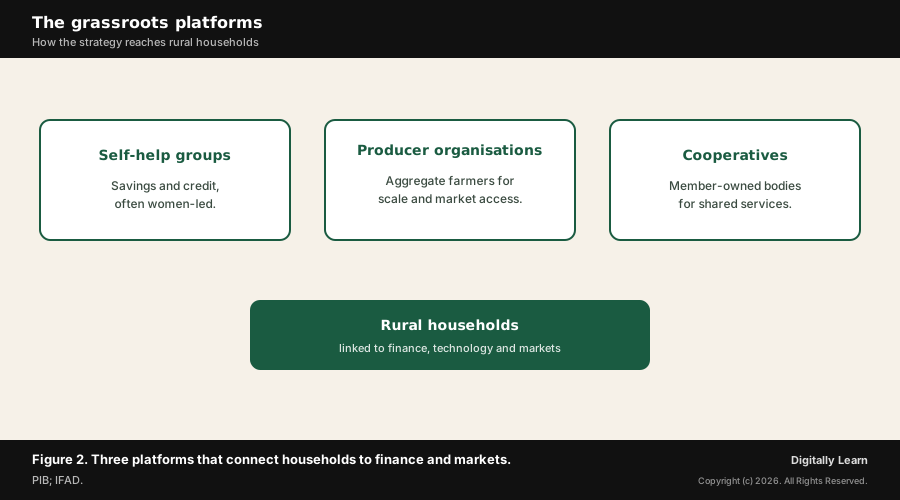
The COSOP works through proven grassroots institutions. Self-help groups, producer organisations and cooperatives connect rural households to finance, technology and markets, so building on them scales impact faster.
It also matters for climate resilience. Rural communities face growing climate stress, so the strategy ties investment to climate-resilient value chains and the protection of farm livelihoods.
What the COSOP signifies
Resilience, institutions and South-South leadership
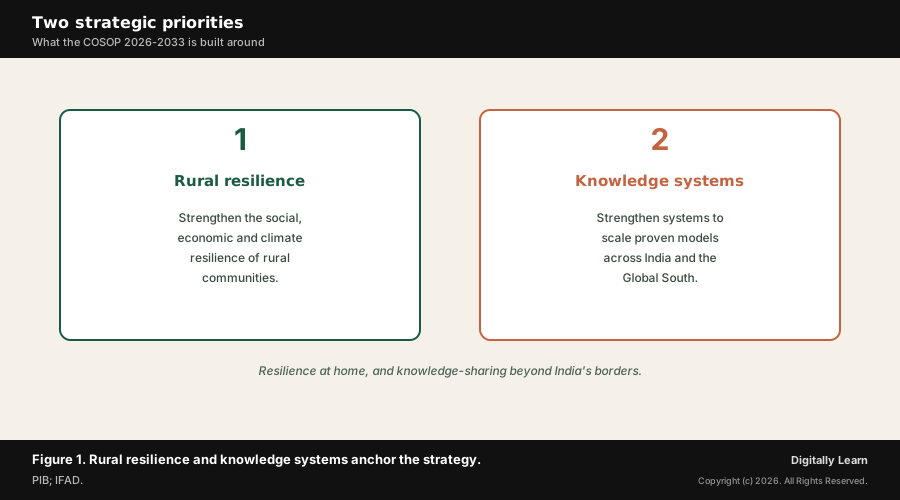
Three threads carry the weight: long-horizon rural investment, the use of grassroots institutions, and India's emerging role as a development knowledge leader.
First, long-horizon investment. An eight-year frame lets projects mature, so finance, infrastructure and markets can be sequenced rather than delivered in short, disconnected bursts.
Second, grassroots institutions. By routing support through self-help groups, producer organisations and cooperatives, the strategy reaches women and small farmers who are often left out of formal finance.
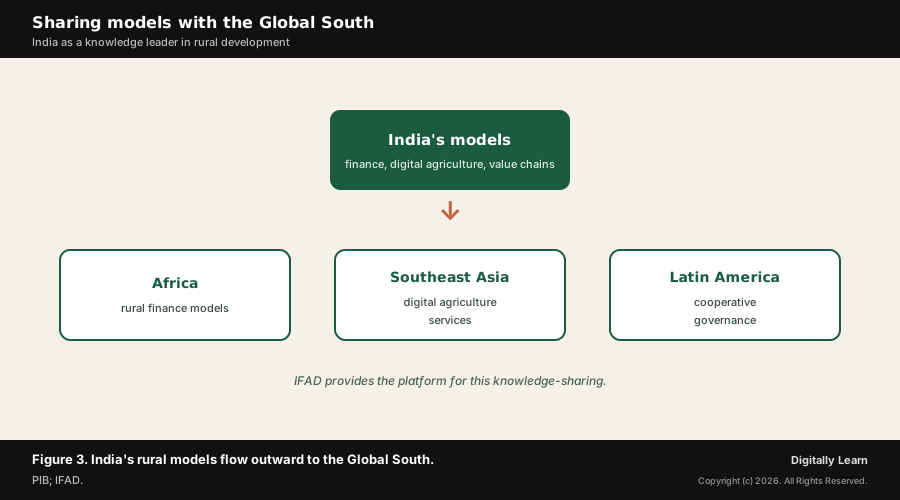
Third, South-South leadership. The COSOP positions India as a knowledge hub, sharing models like rural finance and digital agriculture with partner countries across the Global South.
Distinguishing features of the COSOP
The strategy at a glance
The table sets out the key facts of the COSOP 2026-2033, so its scope and architecture are visible at a glance.
| Feature | Detail |
|---|---|
| Programme | Country Strategic Opportunities Programme (COSOP) |
| Period | Eight years, 2026 to 2033 |
| Alignment | Viksit Bharat@2047 vision |
| Delivery platforms | Self-help groups, FPOs and cooperatives |
| Finance partner | IFAD-NABARD strategic partnership |
Three features that define the strategy
Three elements set this strategy apart from a single project or loan:
- (i) A country strategy, not a project. The COSOP is an overarching framework that guides many investments over eight years.
- (ii) Institution-led delivery. It builds on self-help groups, producer organisations and cooperatives rather than working household by household.
- (iii) Knowledge as an export. It treats India’s proven rural models as something to share with other developing countries.
Observable outcomes
Three trackable outcomes
The COSOP translates into three developments to watch over its eight-year span.
- (a) New rural projects. Fresh IFAD-supported investments can be designed under the strategy and the IFAD-NABARD partnership.
- (b) Wider financial inclusion. More rural women and small farmers can be linked to credit through self-help groups and producer bodies.
- (c) Knowledge exchange. India’s models can be shared with partner countries through South-South cooperation.
A country strategy sets direction; delivery depends on the funding and projects that follow. The real test is how much investment the COSOP mobilises on the ground.
IFAD, rural finance and the Global South
Agricultural development, climate and South-South cooperation
The COSOP sits inside India's wider rural-development and financial-inclusion agenda, where self-help groups and producer organisations have become the main channels for reaching the rural poor.
It connects to climate-resilient agriculture. By tying investment to resilient value chains, the strategy responds to the rising climate stress on farming and rural incomes.
The strategy also advances South-South cooperation. As a specialised United Nations agency focused on rural poverty, IFAD provides a platform for India to share its development experience with the Global South.
UPSC relevance and exam focus
Where this fits in the UPSC-CSE syllabus
This topic maps to General Studies Paper III: agriculture, rural development, inclusive growth and the mobilisation of resources, and to General Studies Paper II: important international institutions and agencies.
For Prelims, hold the high-yield facts: IFAD as a specialised United Nations agency, the meaning of a COSOP, the 2026-2033 period, and the grassroots institutions involved.
For Mains, two framings recur: the role of self-help groups and microfinance in rural empowerment, and the place of financial inclusion in inclusive growth.
Recurring linked concepts an aspirant should keep in working memory:
- IFAD: a specialised United Nations agency focused on rural poverty and agriculture.
- Self-help groups: small savings-and-credit groups, often women-led, linked to banks.
- Farmer producer organisations: bodies that aggregate farmers for scale and market access.
- NABARD: the apex development bank for agriculture and rural India.
The SHG-bank linkage programme was pioneered by NABARD, not by a commercial bank acting alone. Mis-attributing its origin is a frequent error.
Do not treat the COSOP as a single loan. It is a multi-year country strategy, so the analysis should focus on direction and institutions, not one project.
Previous Year UPSC-CSE Questions By the end you will be able to draft model answers for the following UPSC questions. Each question carries a collapsible framework showing how to approach it in the exam.
- UPSC Prelims 2023Consider the following statements regarding the Self-Help Group (SHG) programme:
- The SHG programme was originally initiated by the State Bank of India by providing microcredit to the financially deprived.
- In an SHG, all members of a group take responsibility for a loan that an individual member takes.
- The Regional Rural Banks and Scheduled Commercial Banks support SHGs.
How many of the above statements are correct?
How to approach this Prelims question
Approach: Check each statement against how the SHG-bank linkage actually works and who initiated it.
Trap to watch: Statement 1 is the trap: the SHG-bank linkage was pioneered by NABARD, not the State Bank of India.
Key facts to recall:
- The SHG-bank linkage programme was initiated by NABARD.
- SHGs use joint liability, so members share responsibility for loans.
- Regional Rural Banks and commercial banks support SHGs.
Answer signal: Statements 2 and 3 are correct; statement 1 is not. Correct answer: Only two.
- UPSC Mains 2020 GS-II"Micro-Finance as an anti-poverty vaccine, is aimed at asset creation and income security of the rural poor in India". Evaluate the role of Self-Help Groups in achieving the twin objectives along with empowering women in rural India.
How to structure the answer in the exam
Introduction: Open with microfinance and the SHG-bank linkage as instruments of financial inclusion for the rural poor.
Body (sub-themes to develop):
- Asset creation: small loans for productive assets and enterprises.
- Income security: smoothing consumption and reducing dependence on moneylenders.
- Women's empowerment: agency, savings habits and collective bargaining through SHGs.
- Limits: small loan sizes, uneven group quality and over-indebtedness risks.
- The COSOP's role in scaling SHG-led finance with IFAD and NABARD support.
Conclusion: Conclude that SHG-led microfinance works best when paired with skills, markets and sound institutions.
Sources and Further Reading
Editorial Disclaimer
This article is compiled from the reference materials listed in the Sources section. It is an explainer for UPSC preparation and is not a substitute for primary documents (NCERTs, GoI ministry releases, IMD bulletins, RBI / CEA / MoEFCC publications, and Standing-Committee reports).


