


Overview
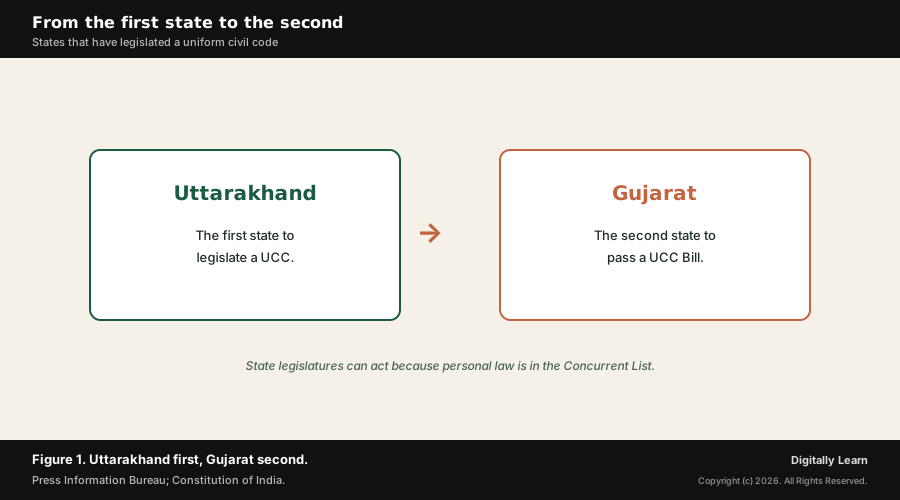
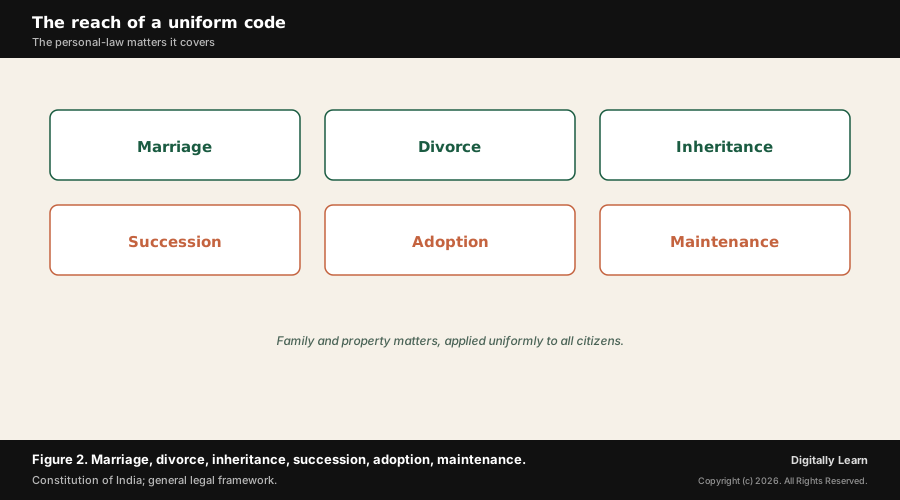
A Uniform Civil Code (UCC) is a single set of personal laws, covering matters such as marriage, divorce, inheritance and succession, that applies to all citizens regardless of religion. The state of Gujarat has passed a Uniform Civil Code Bill, becoming the second Indian state after Uttarakhand to do so. The idea draws on Article 44 of the Constitution, a Directive Principle of State Policy that asks the State to endeavour to secure a uniform civil code. Because personal-law matters lie in the Concurrent List, a state can legislate on them.
Why the Gujarat UCC is in focus
A second state legislates a UCC
The state of Gujarat has passed a Uniform Civil Code Bill in its legislative assembly. With this, Gujarat becomes the second Indian state, after Uttarakhand, to legislate a uniform civil code.
A uniform civil code is a common set of personal laws, on matters like marriage, divorce, inheritance and succession, that applies to all citizens alike, rather than separate rules based on religious community.
The bill followed the work of a state-appointed expert committee, which studied the question and recommended a framework after wide public consultation across the state.
The key elements of the development are:
- Legislation: the Gujarat assembly passed a Uniform Civil Code Bill.
- Sequence: Gujarat is the second state to do so, after Uttarakhand.
- Basis: the idea rests on Article 44 of the Constitution.
- Process: it drew on an expert committee’s study and public consultation.
Why the move matters
A long-debated constitutional goal
A uniform civil code has been debated since the framing of the Constitution. A second state legislating one moves the idea from principle towards practice, and shapes the wider national conversation.
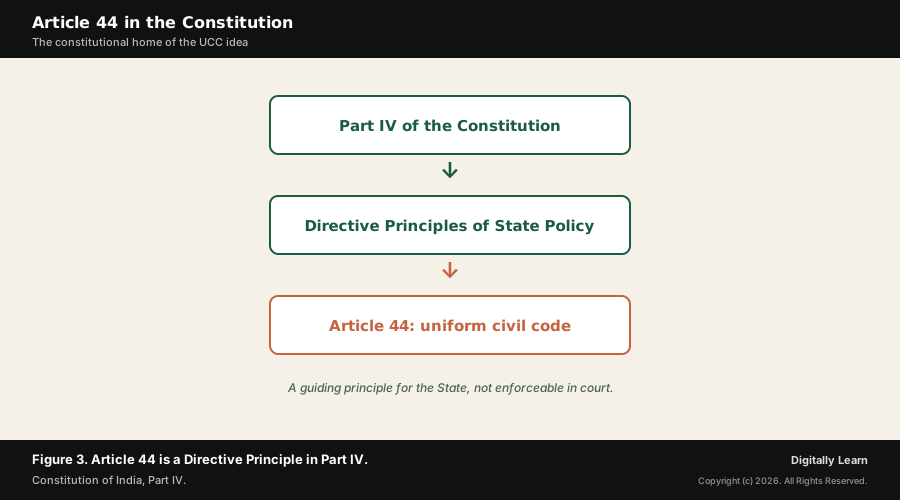
Article 44 places a uniform civil code among the Directive Principles, which guide the State but are not enforceable in court. State-level codes show how that non-binding goal can be acted on.
It also matters for federal practice. Because personal-law subjects sit in the Concurrent List, both Parliament and state legislatures can act, so reform can proceed state by state rather than only nationally.
What the move signifies
A live principle, a two-sided debate, and federal reform
Three threads carry the weight: a Directive Principle put into practice, a balanced debate, and reform through the states.
First, a principle in practice. Article 44 has long been an aspiration; state legislation tests how a uniform code can be designed and applied in real conditions.
Second, a two-sided debate. Supporters argue a uniform code can advance equality and simplify the law; others caution that it must respect India's religious and cultural diversity. Both views are part of the discussion.
Third, reform through the states. Because personal law is a shared subject, states can experiment, and their codes may inform any future national debate on the question.
Distinguishing features of a UCC
The development at a glance
The table sets out the key facts, so the nature and basis of the development are visible at a glance.
| Feature | Detail |
|---|---|
| What | A Uniform Civil Code Bill passed by Gujarat |
| Sequence | Second state, after Uttarakhand |
| Constitutional basis | Article 44 (Directive Principle) |
| Subject placement | Personal law is in the Concurrent List |
| Process | Expert committee study and public consultation |
Three features that define a UCC
Three elements define what a uniform civil code seeks to do:
- (i) Common personal law. It applies the same rules of marriage, divorce and succession to all citizens.
- (ii) Religion-neutral. It replaces community-specific personal laws with a single civil framework.
- (iii) Civil, not criminal. It governs family and property matters, not crimes, which are already common to all.
Observable outcomes
Three trackable outcomes
The development translates into three things to watch in the period ahead.
- (a) Rules and rollout. The state will frame rules and set up systems to put the code into effect.
- (b) Legal review. Any code is open to examination by the courts on constitutional questions.
- (c) Wider debate. Other states and the national discussion may respond to the Gujarat and Uttarakhand experience.
Passing a law is the first step. How a code is implemented, and how it is received across communities, will shape its real effect.
The Constitution, the courts and the wider debate
Article 44, the DPSP and personal-law reform
The idea rests on Article 44, which sits in Part IV of the Constitution, the Directive Principles of State Policy, and asks the State to endeavour to secure a uniform civil code.
It connects to the nature of the Directive Principles, which are not enforceable in court but are meant to guide law-making. A uniform code is one way a state acts on that guidance.
It also links to the courts, which over the years have observed on the subject in various judgments, and to the wider goal of balancing equality with India's diversity.
UPSC relevance and exam focus
Where this fits in the UPSC-CSE syllabus
This topic maps to General Studies Paper II: Indian Constitution, Directive Principles, and the federal structure, with links to social justice.
For Prelims, hold the high-yield facts: Article 44 as the constitutional basis, the Directive Principles as non-justiciable, and the placement of personal law in the Concurrent List.
For Mains, two framings recur: the factors that have inhibited a uniform civil code, and the balance between uniformity and diversity.
Recurring linked concepts an aspirant should keep in working memory:
- Article 44: the Directive Principle on a uniform civil code.
- Directive Principles: non-justiciable guides to State policy.
- Concurrent List: where personal-law subjects are placed.
- Personal law: rules on marriage, divorce, inheritance and the like.
Article 44 is a Directive Principle, not a Fundamental Right, so it is not directly enforceable in court. Treating it as a right is an error.
A balanced answer weighs both the case for a uniform code and the need to respect diversity, rather than arguing only one side.
Previous Year UPSC-CSE Questions By the end you will be able to draft model answers for the following UPSC questions. Each question carries a collapsible framework showing how to approach it in the exam.
- UPSC Mains 2015 GS-IIDiscuss the possible factors that inhibit India from enacting for its citizens a uniform civil code as provided for in the Directive Principles of State Policy.
How to structure the answer in the exam
Introduction: Open with Article 44 as a Directive Principle on a uniform civil code.
Body (sub-themes to develop):
- Diversity of personal laws across communities.
- Concerns about respecting religious and cultural freedom.
- Federal and political sensitivities of the subject.
- Arguments for equality, gender justice and simpler law.
- State-level codes in Uttarakhand and Gujarat as recent steps.
Conclusion: Conclude that careful, consultative reform is needed to balance uniformity with diversity.
- UPSC Prelims 2012Consider the following provisions under the Directive Principles of State Policy as enshrined in the Constitution of India:
- Securing for citizens of India a uniform civil code
- Organizing village Panchayats
- Promoting cottage industries in rural areas
- Securing for all the workers reasonable leisure and cultural opportunities
Which of the above are the Gandhian Principles that are reflected in the Directive Principles of State Policy?
How to approach this Prelims question
Approach: Classify each Directive Principle as Gandhian or otherwise.
Trap to watch: Village panchayats and cottage industries are Gandhian principles; the uniform civil code and workers' leisure are not, so the answer is 2 and 3 only.
Key facts to recall:
- Gandhian principles include village panchayats and cottage industries.
- The uniform civil code is a liberal-intellectual principle under Article 44.
- Directive Principles are grouped into Gandhian, socialist and liberal-intellectual types.
Answer signal: Only the Gandhian provisions count. Correct answer: 2 and 3 only.
Sources and Further Reading
- Press Information Bureau: Amit Shah congratulates Gujarat CM and legislators on the passage of the Uniform Civil Code Bill
- Constitution of India: Article 44 (Directive Principles of State Policy)
- Government of Gujarat: Legislative and Parliamentary Affairs Department
- Press Information Bureau: Law Commission of India on the Uniform Civil Code
- Wikipedia: Uniform Civil Code
- Wikipedia: Directive Principles of State Policy (India)
Editorial Disclaimer
This article is compiled from the reference materials listed in the Sources section. It is an explainer for UPSC preparation and is not a substitute for primary documents (NCERTs, GoI ministry releases, IMD bulletins, RBI / CEA / MoEFCC publications, and Standing-Committee reports).


