


Overview
Conferred on PM Modi
FAO honours India's food-security leadership at Rome HQ; second Indian PM to receive the medal after Manmohan Singh.
The Agricola Medal is a distinction conferred by the Director-General of the Food and Agriculture Organization (FAO) of the United Nations on extraordinary leaders who demonstrate commitment and action in support of FAO's mandate to eradicate hunger, reduce poverty, and ensure food security and nutrition for all. On 20 May 2026 at FAO Headquarters in Rome, the medal was conferred on Prime Minister Narendra Modi by Director-General QU Dongyu.
Why this is in the news on 21 May 2026
The Rome ceremony and the recognition citation
On 20 May 2026, Prime Minister Narendra Modi received the FAO Agricola Medal at the Plenary Hall of FAO Headquarters in Rome. The medal was conferred by FAO Director-General QU Dongyu during the same visit on which the India-Italy ties were elevated to a Special Strategic Partnership.
Definition: The Agricola Medal is a distinction conferred by the FAO Director-General on extraordinary leaders demonstrating commitment to FAO's mandate of eradicating hunger, reducing poverty, and ensuring food security and nutrition for all. It is not annual; it is conferred selectively as the Director-General recognises specific leadership.
Three headline outcomes define the conferral:
- (i) Recognition citation. Awarded in recognition of exceptional leadership on food security, sustainable agriculture, and rural development at the national and global level.
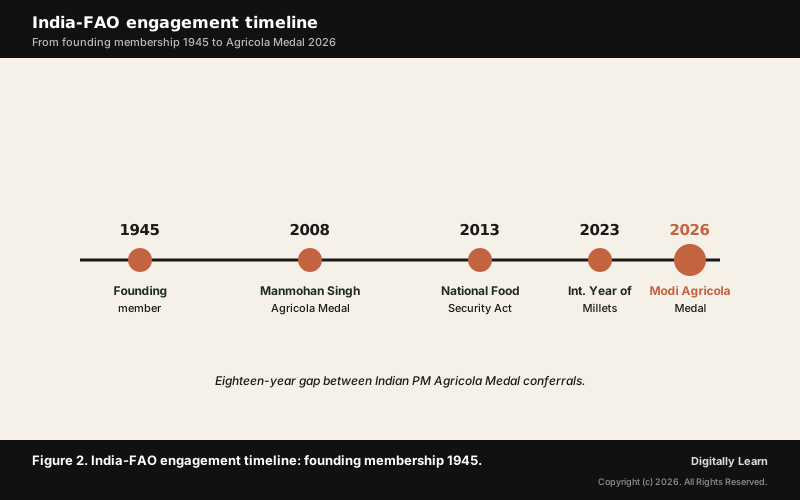
- (ii) Historical sequence. Modi is the second Indian Prime Minister to receive the Agricola Medal after Manmohan Singh received it in 2008.
- (iii) Bilateral marker. The visit was the first by an Indian Head of Government to FAO Headquarters in 30 years, signalling renewed institutional engagement.
Why FAO recognition matters for Indian agricultural diplomacy
Why FAO recognition is institutional currency
Why it matters: FAO recognition is institutional currency in multilateral agricultural diplomacy. It signals alignment between national policy priorities and the FAO mandate on hunger, food security, and rural development, and it strengthens India's voice in FAO governance bodies including the FAO Council and the Committee on World Food Security.
The medal also matters because it links to India's International Year of Millets, 2023 proposal that the UN General Assembly accepted, the Indian Council of Agricultural Research partnerships with FAO, and the broader South-South cooperation on agricultural extension. The 30-year gap in head-of-government visits had created a presence deficit that the Rome ceremony begins to close.
Significance for India's food-security narrative
What the Agricola Medal signals for Indian food-security diplomacy
What is the significance of this issue: The Agricola Medal conferral carries three significances for India's food-security narrative:
- (i) Schemes-portfolio signal. The recognition consolidates India’s portfolio of food-security and farm-support schemes including the National Food Security Act, 2013, PM-KISAN, Pradhan Mantri Fasal Bima Yojana, the Public Distribution System, and the One Nation One Ration Card as a coherent global-mandate-aligned package.
- (ii) Millets-leadership signal. The International Year of Millets, 2023 declaration was an India-led proposal at the UN; the medal reinforces India’s position as a thought-leader on climate-resilient cereal diversification.
- (iii) South-South-cooperation signal. The FAO recognition strengthens India’s position in South-South cooperation on extension services, irrigation technology transfer, and seed-system support to African and South Asian partner countries.
Structural reading: The historical sequence (Manmohan Singh in 2008, Modi in 2026) reflects an FAO pattern of recognising specific governments that scale national food-security legislation. The 2008 conferral preceded the National Food Security Act, 2013; the 2026 conferral lands in the post-NFSA implementation phase.
Distinguishing features of FAO and the Agricola Medal
How the FAO governance structure is built
Distinguishing features: Three institutional pillars give the Agricola Medal its institutional weight:
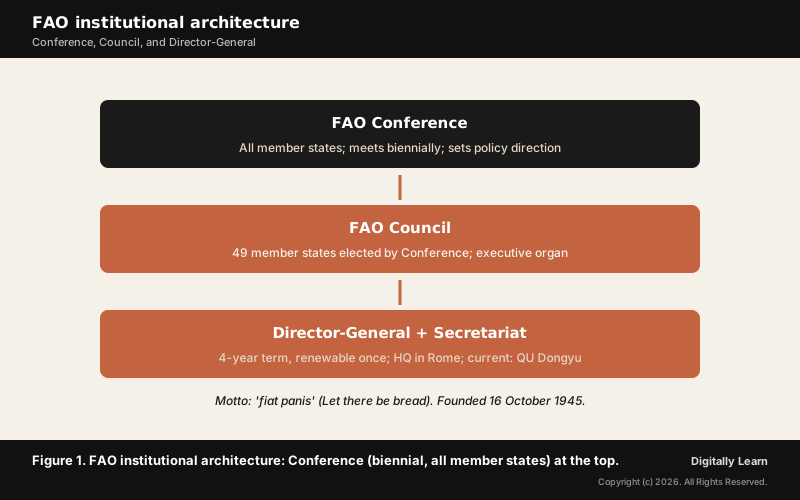
- (i) Founding and mandate. The Food and Agriculture Organization was founded on 16 October 1945 in Quebec City, Canada, and is headquartered in Rome. Its motto ‘fiat panis’ (Let there be bread) frames the institutional purpose.
- (ii) Governance. The FAO is governed by the biennial Conference of all member states and the Council of 49 member states elected by the Conference. The Director-General serves a four-year term, renewable once; the current incumbent is QU Dongyu of China, in his second term.
- (iii) Indian membership and engagement. India has been a member of the FAO since its founding in 1945. The Indian Council of Agricultural Research, the Ministry of Agriculture and Farmers Welfare, and the Department of Food and Public Distribution are the principal Indian institutional partners.
The FAO Agricola Medal conferral at a glance
| Conferral element | Detail | Significance |
|---|---|---|
| Award | FAO Agricola Medal 2026 | Distinction by FAO Director-General |
| Recipient | Prime Minister Narendra Modi | Conferred for food-security and sustainable-agriculture leadership |
| Date and venue | 20 May 2026, FAO Headquarters Plenary Hall, Rome | Side-event of the India-Italy Rome visit |
| Conferring authority | Director-General QU Dongyu (FAO) | Director-General-level recognition |
| Historical sequence | Second Indian PM after Manmohan Singh (2008) | Eighteen-year gap between Indian PM conferrals |
| Indian PM visit to FAO HQ | First in 30 years | Reset of head-of-government level engagement |
| FAO founding | 16 October 1945, Quebec City; HQ Rome | Standing UN specialised agency |
| FAO motto | fiat panis (Let there be bread) | Frame on hunger eradication and food security |
| India's institutional partners | ICAR, Ministry of Agriculture, Department of Food and PD | Operational engagement surface |
Observable outcomes to track after the conferral
What to watch on India's FAO engagement through 2030
Observable outcomes: Five outcomes frame the FAO engagement trajectory between 2026 and 2030:
- (a) India in FAO governance. Indian positions and votes in the biennial FAO Conference and the FAO Council; Indian nominations for the FAO Independent Chairperson and bureau positions.
- (b) Millets follow-through. Post-IYM-2023 institutional architecture: FAO-led millet-trade promotion, sub-Saharan extension support, and the Indian millets-export trajectory.
- (c) South-South extension partnerships. Specific FAO-supported triangular cooperation projects with African and South Asian partner countries on irrigation, seed systems, and post-harvest losses.
- (d) Climate-resilience programming. FAO-supported integration of climate-resilient agriculture into Indian extension architecture under the Pradhan Mantri Krishi Sinchayee Yojana and the National Mission for Sustainable Agriculture.
- (e) Committee on World Food Security engagement. Indian participation in the CFS High-Level Panel of Experts and in Voluntary Guidelines on Right to Food.
Threads connecting the conferral to wider Indian agricultural policy
How the medal connects to NFSA 2013, the agricultural revolutions, and South-South cooperation
Contemporary linkages: Three threads connect the Agricola Medal conferral to wider Indian agricultural policy.
The first is the NFSA 2013 linkage. The National Food Security Act, 2013 provides legal entitlement to subsidised foodgrains to up to 75 per cent of the rural and 50 per cent of the urban population through the targeted Public Distribution System. The FAO recognition affirms the legislative architecture as the central pillar of the Indian food-security model.
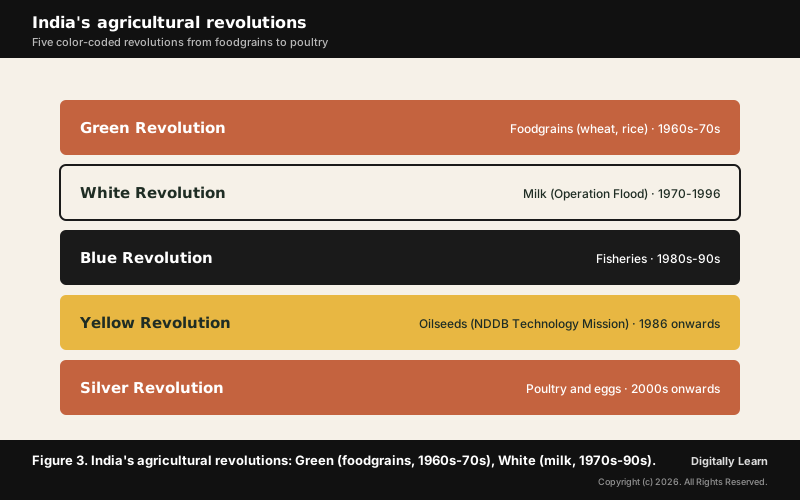
The second is the agricultural-revolutions linkage. The conferral references India's revolutions sequence (Green Revolution, White Revolution, Blue Revolution, Yellow Revolution, Silver Revolution, and the post-2014 push on horticulture and millets) as the structural base on which the food-security architecture rests.
The third is the South-South-cooperation linkage. The medal frames India as a thought-partner for FAO programming in sub-Saharan Africa, South Asia, and small-island developing states. The India-UN Development Partnership Fund and the India-Africa Forum Summit commitments are the operational instruments.
UPSC Relevance
Where the conferral sits in the UPSC syllabus
UPSC context: The FAO Agricola Medal conferral falls within General Studies Paper II under the head important International institutions, agencies and fora, their structure, mandate, and within General Studies Paper III under the heads major crops and cropping patterns, issues related to direct and indirect farm subsidies and minimum support prices, public distribution system, and food processing.
Prelims relevance: The Prelims surface includes FAO founding date 16 October 1945, headquarters Rome, motto fiat panis, current Director-General QU Dongyu, governance through Conference and Council, and the Agricola Medal as a Director-General-conferred distinction.
Prelims also covers the 2008 Manmohan Singh precedent conferral, the International Year of Millets, 2023, the National Food Security Act, 2013, the Public Distribution System, PM-KISAN, the Pradhan Mantri Fasal Bima Yojana, the One Nation One Ration Card, and the five colour-coded agricultural revolutions.
Mains relevance: Two framings dominate the Mains-paper surface:
- (i) NFSA-2013 framing. How the National Food Security Act, 2013 has helped eliminate hunger and malnutrition in India. The medal cites this legislative architecture as the operational base of India’s food-security model.
- (ii) Agricultural-revolutions framing. What revolutions occurred in Indian agriculture after Independence, and how they helped poverty alleviation and food security. The medal cites the cumulative legacy of the five revolutions.
Mains practice question: A focused fifteen-mark question would read: The 2026 conferral of the FAO Agricola Medal on the Indian Prime Minister reflects the institutional recognition of India's food-security architecture. Examine the contribution of the National Food Security Act, 2013 and the agricultural revolutions to this recognition.
- Past Mains linkage. 2021 GS-III: What are the salient features of the National Food Security Act, 2013? How has the Food Security Bill helped in eliminating hunger and malnutrition in India? The NFSA architecture is the legislative base on which the FAO recognition rests.
- Past Mains linkage. 2017 GS-III: Explain various types of revolutions, took place in Agriculture after independence in India. How these revolutions have helped in poverty alleviation and food security in India? The five revolutions are the structural base the FAO recognition celebrates.
- Related linkage. Prelims questions on FAO governance, the IYM-2023 declaration, and the five revolutions test the institutional surface.
Previous Year UPSC-CSE Questions By the end you will be able to draft model answers for the following UPSC questions. Each question carries a collapsible framework showing how to approach it in the exam.
- UPSC Mains 2021 GS-IIIWhat are the salient features of the National Food Security Act, 2013? How has the Food Security Bill helped in eliminating hunger and malnutrition in India?
How to structure the answer in the exam
Introduction: Open with the NFSA 2013 enactment in September 2013, name the rights-based shift from welfare to legal entitlement, and frame the answer through five salient features and three impact channels.
Body (sub-themes to develop):
- Coverage: up to 75 per cent of the rural population and 50 per cent of the urban population eligible for subsidised foodgrains; National Food Security identification through Socio-Economic and Caste Census surrogates.
- Entitlement: 5 kg of foodgrains per person per month under Priority Households; 35 kg per household under Antyodaya Anna Yojana; uniform prices: rice 3 rupees, wheat 2 rupees, coarse grains 1 rupee per kg.
- Maternity and child nutrition: 6,000 rupees maternity benefit per pregnant or lactating woman; mid-day meal for school children; supplementary nutrition for children under six through Anganwadi.
- Identification and grievance redressal: Eligible Households identification by State Governments; District Grievance Redressal Officer; State Food Commission; portability through One Nation One Ration Card.
- Impact channels: NFHS-5 (2019-2021) anaemia and stunting figures; FCI annual offtake under NFSA; food-inflation pass-through to the targeted population; Global Hunger Index ranking trajectory.
- Limitations: nutritional-content vs caloric-content gap; rural and urban portability friction pre-ONORC; child-stunting persistence at 35.5 per cent under NFHS-5; need for IYM-2023 millet integration for dietary diversity.
Conclusion: Conclude that the NFSA 2013 architecture has shifted India's food security from welfare to legal entitlement, that the elimination claim is partial (caloric secured but nutritional gaps remain), and that the 2026 FAO Agricola Medal conferral reflects the institutional recognition of this rights-based architecture.
The NFSA 2013 is the central legislative architecture the FAO Agricola Medal cites for India's food-security leadership. The body sub-theme on impact channels supplies the data points a good answer to the 2021 question must include.
- UPSC Mains 2017 GS-IIIExplain various types of revolutions, took place in Agriculture after independence in India. How these revolutions have helped in poverty alleviation and food security in India?
How to structure the answer in the exam
Introduction: Open with the 1947 starting point of Indian self-sufficiency-deficit, name the five colour-coded revolutions chronologically (Green, White, Blue, Yellow, Silver), and frame the contribution assessment through three poverty-and-security channels.
Body (sub-themes to develop):
- Green Revolution (1960s-70s): high-yielding-variety seeds, fertilisers, irrigation, and assured procurement at minimum support prices; led by Norman Borlaug-inspired research at IARI and the Punjab-Haryana-western UP wheat belt; transformed India from a foodgrain-importing country to a surplus producer.
- White Revolution (1970-1996): Operation Flood programme of the National Dairy Development Board led by Dr Verghese Kurien; Anand pattern of dairy cooperatives; transformed India into the world's largest milk producer.
- Blue Revolution (1980s-90s): fisheries development through the Indian Council of Agricultural Research and the Marine Products Export Development Authority; brackish-water aquaculture and inland fisheries.
- Yellow Revolution (1986 onwards): Technology Mission on Oilseeds; oilseed production rose from 11 million tonnes (1986-87) to over 35 million tonnes; reduced edible-oil import dependence partially.
- Silver Revolution (2000s onwards): poultry and egg production; National Egg Coordination Committee architecture; egg production rose from 28 billion (1990s) to over 130 billion eggs (mid-2020s).
- Poverty-and-food-security contribution: foodgrain self-sufficiency since the late 1970s; rural employment under the revolutions' allied activities; dietary-diversification gains through milk, oilseeds, fish, and poultry.
Conclusion: Conclude that the five revolutions cumulatively shifted India from food-import dependence to a surplus-producer and export-capable position, that their poverty-alleviation contribution was channel-specific (foodgrain self-sufficiency, dairy employment, fisheries livelihoods), and that the 2026 FAO Agricola Medal conferral recognises the cumulative legacy.
The five agricultural revolutions are the structural base the FAO Agricola Medal cites for India's poverty-alleviation-and-food-security contribution. The body sub-theme on Green Revolution and White Revolution supplies the strongest evidence for any answer to the 2017 question.
Sources
- FAO Director General honours India's Prime Minister Narendra Modi with FAO's Agricola Medal
- Prime Minister receives Agricola Medal from FAO in Rome
- National Food Security Act, 2013 (consolidated text)
- International Year of Millets 2023 declaration
- Ministry of Agriculture and Farmers Welfare: PM-KISAN and PMFBY
- Indian Council of Agricultural Research: ICAR-FAO partnerships
- Wikipedia: Agricola Medal
Editorial Disclaimer
This article is compiled from the reference materials listed in the Sources section. It is an explainer for UPSC preparation and is not a substitute for primary documents (NCERTs, GoI ministry releases, IMD bulletins, RBI / CEA / MoEFCC publications, and Standing-Committee reports).


