


Overview
12-Nation Drill at Umroi
India's maiden multilateral army exercise opens at Umroi, Meghalaya; twelve friendly nations train on counter-terrorism.
Exercise PRAGATI 2026 is a multilateral military exercise hosted by the Indian Army, whose maiden edition commenced on 20 May 2026 at the Umroi Military Station in Meghalaya. The acronym expands to Partnership of Regional Armies for Growth and Transformation in the Indian Ocean Region, and the exercise brings together 12 friendly nations in a spirit of equality, friendship, and mutual respect. The two-week drill focuses on counter-terrorism operations in semi-mountainous and jungle terrain, building closer military-to-military ties through joint training and professional exchange.
Why this is in the news on 20 May 2026
Exercise PRAGATI 2026 commences at Umroi, Meghalaya
On 20 May 2026, the multilateral military Exercise PRAGATI 2026 commenced at the Umroi Military Station in Meghalaya. The maiden edition brings together armed-forces contingents from 12 friendly nations for a two-week schedule of joint training and professional exchange.
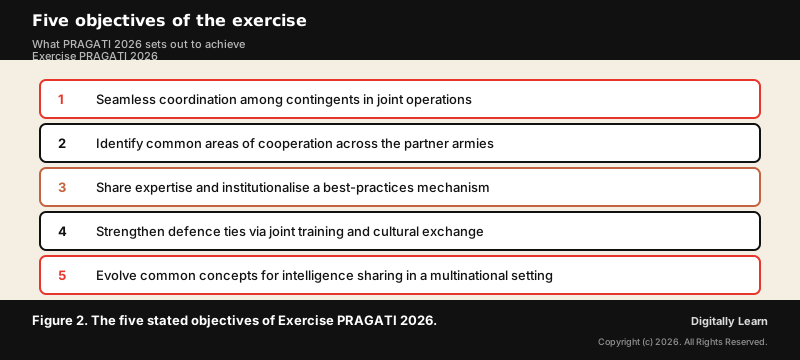
Definition: The acronym PRAGATI expands to Partnership of Regional Armies for Growth and Transformation in the Indian Ocean Region. The exercise is built around the values of equality, friendship, and mutual respect, and it serves as a platform for professional exchange and for closer military-to-military ties among the participating armies.
The opening ceremony was led by Major General Sunil Sheoran, the Additional Director General of Infantry of the Indian Army, who welcomed all contingents and stressed the value of collective engagement against contemporary security challenges. Three points frame the launch:
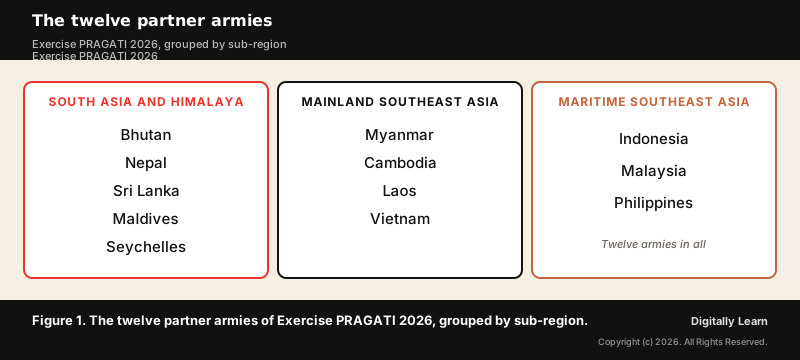
- (i) Participating nations. The twelve partner armies are Bhutan, Cambodia, Indonesia, Laos, Malaysia, Maldives, Myanmar, Nepal, Philippines, Seychelles, Sri Lanka, and Vietnam. The list spans the eastern Indian Ocean, the Bay of Bengal littoral, mainland and maritime Southeast Asia, and India’s immediate Himalayan neighbourhood.
- (ii) Training focus. The two-week exercise concentrates on counter-terrorism operations in semi-mountainous and jungle terrain. Mixed teams undertake joint planning, tactical-level drills, and coordinated operations, with a sustained emphasis on physical fitness, discipline, and coordination across national contingents.
- (iii) Self-reliance showcase. Indian defence companies display indigenous equipment and innovations at Umroi under the Atmanirbhar Bharat initiative. The visiting delegations see homegrown weaponry, surveillance systems, and communication gear, which links the exercise to India’s defence-manufacturing and export ambitions.
Why Exercise PRAGATI matters for regional security cooperation
From bilateral drills to a standing multilateral platform
Why it matters: PRAGATI matters because it moves India's regional defence engagement beyond a set of separate bilateral drills into a single multilateral forum where twelve partner armies plan, train, and operate together under one framework. The shift creates shared tactical vocabulary and habits of cooperation that bilateral formats cannot easily build.
The exercise matters because the participating states face a common spectrum of non-traditional security threats: cross-border terrorism, insurgency in difficult terrain, and the protection of maritime approaches in the wider Indian Ocean Region. Training together in jungle and semi-mountainous conditions builds the practical interoperability that a future coordinated response would demand.
Significance for India's Indian Ocean and defence-diplomacy posture
What hosting Exercise PRAGATI signals for India's regional role
What is the significance of this exercise: Hosting Exercise PRAGATI 2026 carries three significances for India's standing in the Indian Ocean Region and its wider defence-diplomacy posture:
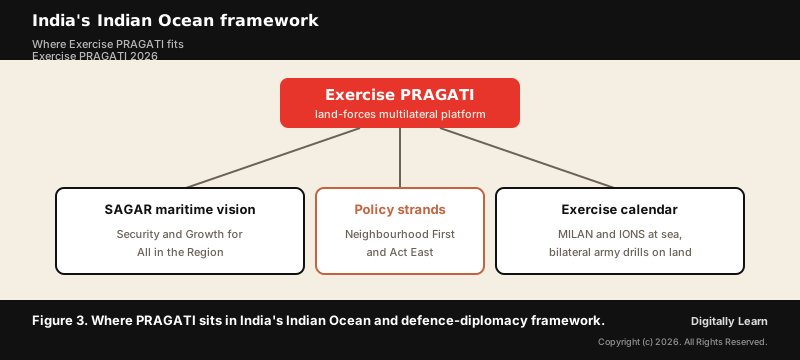
- (i) Net-security-provider signal. By convening twelve regional armies for a common counter-terrorism drill, India advances its long-stated ambition to act as a net security provider in the Indian Ocean Region. The exercise complements naval engagements such as MILAN and the IONS framework with a dedicated land-forces platform.
- (ii) Neighbourhood and Act East signal. The guest list folds India’s Neighbourhood First partners (Bhutan, Nepal, Sri Lanka, Maldives) together with its Act East partners in mainland and maritime Southeast Asia. PRAGATI therefore knits two distinct strands of Indian foreign policy into one military-cooperation forum.
- (iii) Defence-manufacturing signal. The display of indigenous equipment under Atmanirbhar Bharat turns the exercise into a soft-power and export shop-window. Visiting delegations evaluate Indian weaponry and systems in a live training setting, which supports India’s stated goal of expanding defence exports.
Distinguishing features of Exercise PRAGATI 2026
What sets this exercise apart from earlier bilateral drills
Distinguishing features: Three features distinguish Exercise PRAGATI 2026 from India's earlier army-to-army engagements:
- (i) Scale of participation. Most of India’s recurring army exercises are bilateral, such as the drills run with single partners. PRAGATI is multilateral by design, assembling twelve armies in mixed teams so that troops from different countries train side by side rather than in separate national blocks.
- (ii) Thematic and terrain focus. The exercise is built around counter-terrorism operations in semi-mountainous and jungle terrain, a setting the Northeast provides naturally at Umroi. The schedule combines joint planning, tactical-level drills, and coordinated operations rather than a ceremonial parade format.
- (iii) Equality-based framing. The exercise is framed around equality, friendship, and mutual respect and positions itself as a platform for professional exchange. The intent is closer military-to-military ties built through cultural exchange and shared best practices, not a hierarchy between host and guests.
Exercise PRAGATI 2026 at a glance
| Exercise parameter | Detail | Significance |
|---|---|---|
| Exercise | Multilateral military Exercise PRAGATI 2026 | Maiden multilateral edition |
| Commencement | 20 May 2026 | Two-week schedule |
| Venue | Umroi Military Station, Meghalaya | Northeast jungle and semi-mountainous terrain |
| Full form | Partnership of Regional Armies for Growth and Transformation in the Indian Ocean Region | Frames the Indian Ocean focus |
| Participants | 12 friendly nations | Neighbourhood-First plus Act East partners |
| Opening dignitary | Major General Sunil Sheoran, Additional Director General of Infantry | Indian Army hosts the exercise |
| Primary focus | Counter-terrorism operations | Joint planning, tactical drills, coordinated operations |
| Training values | Physical fitness, discipline, coordination | Mixed-team interoperability |
| Self-reliance element | Indian defence companies display indigenous equipment | Under Atmanirbhar Bharat |
| Wider frame | Spirit of equality, friendship, mutual respect | Platform for professional exchange |
Observable outcomes to track after the exercise
What to watch on PRAGATI through 2026-27
Observable outcomes: Five outcomes frame the trajectory of Exercise PRAGATI from this maiden edition onward:
- (a) Recurrence and rotation. Whether PRAGATI settles into a recurring multilateral cycle, and whether future editions rotate venues or hosting roles among the twelve partner armies rather than remaining India-hosted.
- (b) Best-practices mechanism. Whether the stated institutional mechanism for exchanging best practices is formally constituted, with a published charter or standing secretariat, rather than ending as a one-off training event.
- (c) Intelligence-sharing concepts. Whether the common concepts for managing and sharing intelligence in a multinational environment translate into durable arrangements after the troops disperse.
- (d) Defence-export traction. Whether the Atmanirbhar Bharat showcase converts into procurement interest or export enquiries from participating states for Indian-made systems.
- (e) Partner-set expansion. Whether subsequent editions add new partner armies from the Indian Ocean littoral, widening the platform beyond the founding twelve.
Threads connecting PRAGATI to India's wider security architecture
How PRAGATI connects to SAGAR, Act East, and India's exercise calendar
Contemporary linkages: Three threads connect Exercise PRAGATI 2026 to the wider Indian Ocean and defence-cooperation framework.
The first is the maritime-vision thread. India's SAGAR vision (Security and Growth for All in the Region, articulated in 2015) and its successor framing MAHASAGAR set out India's role as a security partner across the Indian Ocean. PRAGATI gives the land-forces dimension to a vision that has so far been carried mainly by the Navy.
The second is the policy-strand thread. The Neighbourhood First policy and the Act East policy together define India's outreach to South Asia and to Southeast Asia respectively. PRAGATI is unusual because its guest list fuses both strands, treating the partner states as a single regional-security community rather than two separate baskets.
The third is the exercise-calendar thread. India runs a dense schedule of joint drills, including the naval gathering MILAN, the multinational maritime forum IONS, and numerous bilateral army exercises. PRAGATI adds a standing multilateral land exercise to this calendar, deepening the Indian Ocean cooperation that runs alongside groupings such as the Quad and BIMSTEC.
UPSC Relevance
Where Exercise PRAGATI sits in the UPSC syllabus
UPSC context: Exercise PRAGATI 2026 sits across two General Studies papers. Under General Studies Paper II it maps to India and its neighbourhood relations, bilateral, regional and global groupings and agreements involving India, and effect of policies and politics of developed and developing countries on India's interests. Under General Studies Paper III it maps to security challenges and their management and role of external state and non-state actors in creating challenges to internal security.
Prelims relevance: The Prelims surface includes the full form of PRAGATI (Partnership of Regional Armies for Growth and Transformation in the Indian Ocean Region), the venue at Umroi in Meghalaya, the 20 May 2026 commencement, the twelve participating nations, the counter-terrorism focus, and the link to the Atmanirbhar Bharat defence-manufacturing drive. Examiners frequently test which countries take part in a named exercise and which service of the armed forces hosts it.
Mains relevance: Two framings dominate the Mains-paper surface:
- (i) Defence-diplomacy framing. How joint military exercises advance India’s role as a security partner in the Indian Ocean Region. PRAGATI supplies a current, named example of land-forces defence diplomacy that fuses Neighbourhood First with Act East.
- (ii) Maritime-and-regional-security framing. How India manages security challenges and builds interoperability with littoral states. PRAGATI illustrates the institutional-mechanism and best-practices dimension that a strong answer on regional security cooperation should name.
Mains practice question: A focused fifteen-mark question would read: Joint military exercises have become a central instrument of India's engagement in the Indian Ocean Region. In the light of Exercise PRAGATI 2026, examine how such exercises advance India's defence-diplomacy objectives.
Previous Year UPSC-CSE Questions By the end you will be able to draft model answers for the following UPSC questions. Each question carries a collapsible framework showing how to approach it in the exam.
- UPSC Mains 2024 GS-IIDiscuss the geopolitical and geostrategic importance of Maldives for India with a focus on global trade and energy flows. Further also discuss how this relationship affects India’s maritime security and regional stability amidst international competition?
How to structure the answer in the exam
Introduction: Open by locating Maldives on the central Indian Ocean sea-lanes through which a large share of India's trade and energy imports pass, and frame the answer around trade, energy, maritime security, and regional stability.
Body (sub-themes to develop):
- Geopolitical value: Maldives lies astride the east-west shipping lanes and choke-point approaches of the central Indian Ocean; its archipelago commands surveillance reach over busy maritime traffic.
- Geostrategic value for trade and energy: a large share of India's seaborne trade and crude-oil imports transit waters close to Maldives, so stability there bears directly on India's energy security.
- Maritime-security bearing: cooperation covers hydrography, white-shipping information exchange, and joint patrolling against piracy, trafficking, and illegal fishing in the exclusive economic zones.
- Regional stability amid competition: extra-regional naval presence and competitive infrastructure financing raise the stakes; India responds through capacity-building, training, and equipment support to partner states.
- Cooperation instruments: India deepens ties through the SAGAR vision, bilateral assistance, and multilateral platforms; Exercise PRAGATI 2026, which includes Maldives among twelve partner armies, shows the land-forces dimension of this engagement.
Conclusion: Conclude that Maldives is central to India's Indian Ocean trade, energy, and security calculus, and that India sustains the relationship through the SAGAR vision and multilateral cooperation such as Exercise PRAGATI 2026.
Relevance to this topic. Maldives is one of the twelve partner armies in Exercise PRAGATI 2026, so the exercise is current evidence for the cooperation instruments this 2024 GS-II question asks about. The body theme on cooperation instruments uses PRAGATI to show the land-forces dimension of India's Indian Ocean engagement.
- UPSC Mains 2022 GS-IIIWhat are the maritime security challenges in India? Discuss the organisational, technical and procedural initiatives taken to improve the maritime security.
How to structure the answer in the exam
Introduction: Open with the scope of India's maritime interests across a long coastline, an extensive exclusive economic zone, and busy Indian Ocean sea-lanes, then frame the answer around challenges and three categories of initiative.
Body (sub-themes to develop):
- Challenges: terrorism and infiltration from the sea, piracy and armed robbery, trafficking, illegal fishing, and contested maritime approaches in the wider region.
- Organisational initiatives: coastal-security architecture coordinating the Navy, Coast Guard, and marine police, and joint operations centres for shared maritime-domain awareness.
- Technical initiatives: coastal-radar surveillance chains, the information-fusion centre for the Indian Ocean Region, and satellite-based vessel tracking.
- Procedural initiatives: standard operating procedures for coastal security, white-shipping agreements, and joint exercises that rehearse coordinated responses.
- Regional cooperation: India builds interoperability and shared procedures with littoral states; Exercise PRAGATI 2026, hosting twelve regional armies, illustrates the cooperation layer that extends maritime-security thinking to a multilateral setting.
Conclusion: Conclude that India meets maritime-security challenges through organisational coordination, technical surveillance, and procedural cooperation, and that multilateral exercises such as Exercise PRAGATI 2026 strengthen the regional dimension of this response.
Relevance to this topic. Exercise PRAGATI 2026 shows the regional-cooperation layer the 2022 GS-III question's procedural-initiatives theme should name. Hosting twelve partner armies for joint counter-terrorism training builds the interoperability that underpins coordinated maritime-security responses across the Indian Ocean Region.
Sources
- Press Information Bureau release on the commencement of Exercise PRAGATI 2026
- Indian Army release on multilateral Exercise PRAGATI 2026
- Ministry of Defence release on Exercise PRAGATI 2026
- India hosts PRAGATI 2026 exercise with 12 friendly nations participating
- DD News report on the multilateral Exercise PRAGATI in Meghalaya
- Press Information Bureau on the Atmanirbhar Bharat defence initiative
- Ministry of External Affairs on the SAGAR vision and Indian Ocean policy
Editorial Disclaimer
This article is compiled from the reference materials listed in the Sources section. It is an explainer for UPSC preparation and is not a substitute for primary documents (NCERTs, GoI ministry releases, IMD bulletins, RBI / CEA / MoEFCC publications, and Standing-Committee reports).


