


Overview
Chandrayaan-2 is India's second lunar mission, whose orbiter has continued to study the Moon since 2019. Its Dual Frequency Synthetic Aperture Radar (DFSAR), which uses L-band and S-band microwaves, has found evidence of subsurface ice in the Moon's south polar region. The finding, from a study led by the Physical Research Laboratory, focused on permanently shadowed craters where sunlight never reaches and temperatures stay extremely low. It strengthens the case that the lunar poles hold water ice below the surface, a resource for future exploration.
Why the Chandrayaan-2 finding is in focus
Radar evidence of ice beneath the south pole
A study using Chandrayaan-2 radar data found evidence of subsurface ice near the Moon's south pole. The orbiter's radar detected signatures consistent with ice buried beneath the surface of shadowed craters.
Subsurface ice is frozen water lying below the lunar soil, or regolith. Unlike surface frost, it is shielded from sunlight, so it can survive in cold traps over long periods.
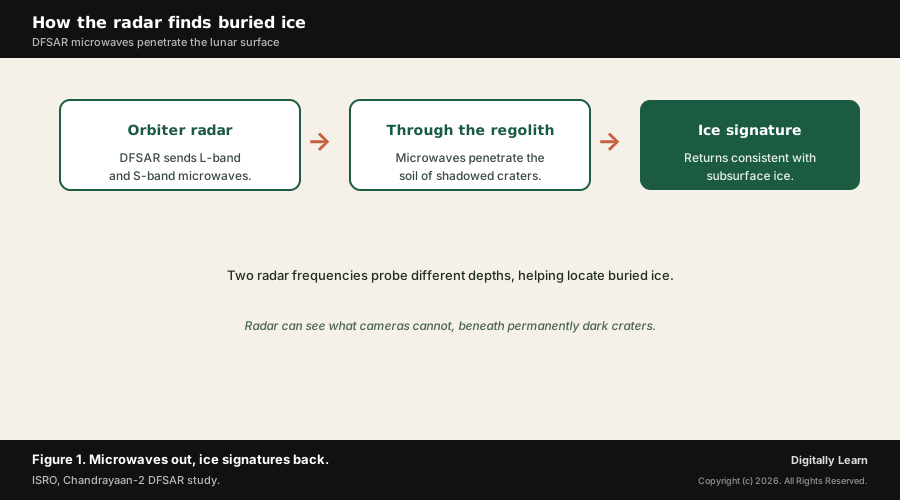
The finding came from the orbiter's Dual Frequency Synthetic Aperture Radar, which uses microwaves that penetrate the surface. The study was led by the Physical Research Laboratory and focused on permanently shadowed craters.
The headline elements of the finding are:
- Instrument: the Dual Frequency Synthetic Aperture Radar, in L-band and S-band.
- Location: permanently shadowed craters near the lunar south pole.
- Finding: radar signatures consistent with subsurface ice.
- Lead: a study led by the Physical Research Laboratory.
Why the finding matters
Water as the key to lunar exploration
Water is the single most valuable resource for exploring the Moon. Carrying it from Earth is hugely expensive, so finding ice in place could transform what missions can do.
Subsurface ice is especially useful. Because it sits below the surface in cold traps, it is more stable than surface frost, so it is a more reliable target for future extraction and study.
The finding also showcases Chandrayaan-2's instruments. Years after launch, the orbiter's radar is still producing front-rank science, underlining the value of long-lived space assets.
What the finding signifies
Resources, the south pole and India's space science
Three threads carry the weight: water as a resource, the value of the lunar south pole, and the strength of India's space science.
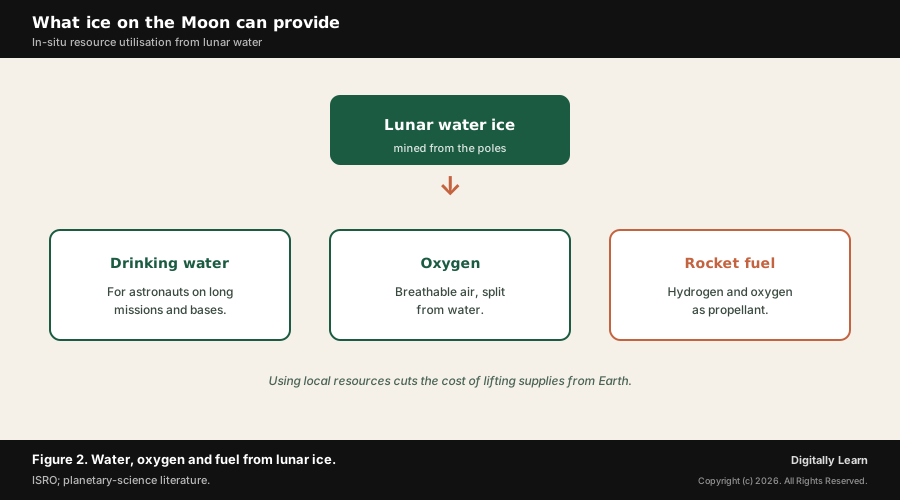
First, water as a resource. Lunar ice could be split into hydrogen and oxygen, supplying drinking water, breathable air and rocket fuel, the building blocks of a sustained presence on the Moon.
Second, the south pole. Its permanently shadowed craters act as cold traps that preserve ice, which is why space agencies, including India, target the region for landings and study.
Third, India's space science. A discovery drawn from an Indian orbiter's instrument, led by an Indian laboratory, shows India contributing front-rank planetary science, not only launches.
Distinguishing features of the finding
The finding at a glance
The table sets out the key facts of the study, so its instrument, location and lead are visible at a glance.
| Feature | Detail |
|---|---|
| Mission | Chandrayaan-2 orbiter (operating since 2019) |
| Instrument | Dual Frequency Synthetic Aperture Radar (DFSAR) |
| Frequencies | L-band and S-band microwaves |
| Location | Permanently shadowed craters near the south pole |
| Lead | Physical Research Laboratory study |
Three features that define the finding
Three elements make this finding notable:
- (i) Subsurface, not surface. The evidence points to ice below the regolith, which is more stable than surface frost.
- (ii) Radar, not cameras. Microwave radar can probe permanently dark craters that optical instruments cannot see into.
- (iii) From an ageing orbiter. The result comes from Chandrayaan-2, years after launch, showing the long life of its science payload.
Observable outcomes
Three trackable outcomes
The finding translates into three developments to watch.
- (a) Target selection. The mapped craters can guide where future landers and rovers are sent to confirm and study the ice.
- (b) Mission planning. Evidence of accessible ice feeds into plans for sample return and longer-stay missions.
- (c) More radar science. Continued DFSAR observations can refine the depth and extent of the ice.
The evidence is of possible ice, not confirmed deposits. Direct measurements on the surface are still needed to prove how much ice exists and how accessible it is.
The finding in India's lunar programme
From Chandrayaan-1 to a global race for lunar water
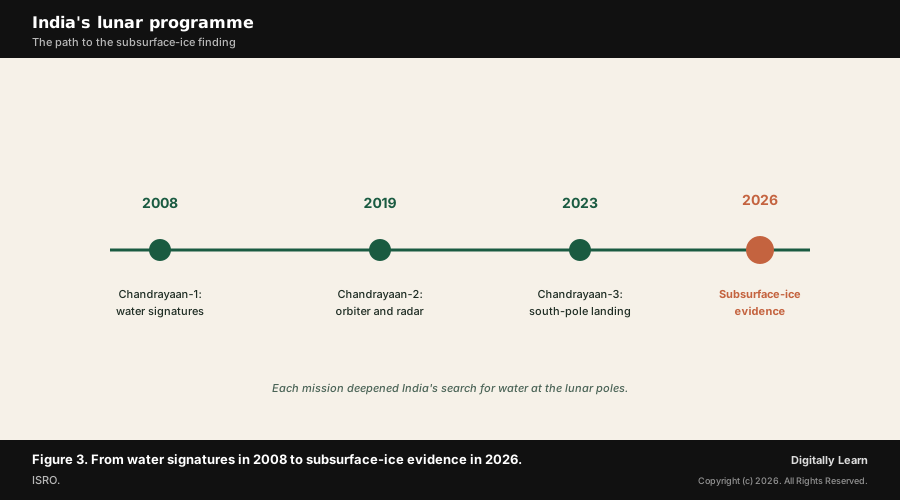
The finding builds on India's lunar programme. Chandrayaan-1 first detected water signatures on the Moon, and Chandrayaan-3 landed near the south pole, the region now in focus.
It connects to a wider race for lunar water. The United States, China and others target the poles, because accessible water would anchor permanent bases and deeper space travel.
The result also strengthens the case for in-situ resource utilisation, the idea of living off local resources rather than carrying everything from Earth, central to the next phase of exploration.
UPSC relevance and exam focus
Where this fits in the UPSC-CSE syllabus
This topic maps to General Studies Paper III: developments in science and technology, and Indians' achievements in space, with a link to India's space programme.
For Prelims, hold the high-yield facts: Chandrayaan-2's DFSAR instrument, the L-band and S-band radar, permanently shadowed regions, and the lunar south-pole focus.
For Mains, two framings recur: India's achievements in space science and exploration, and the strategic value of lunar resources for the future.
Recurring linked concepts an aspirant should keep in working memory:
- DFSAR: the Dual Frequency Synthetic Aperture Radar on the Chandrayaan-2 orbiter.
- Permanently shadowed regions: polar craters that never receive sunlight and trap ice.
- In-situ resource utilisation: using local resources, such as water, instead of carrying them.
- Chandrayaan programme: Chandrayaan-1, Chandrayaan-2 and Chandrayaan-3.
The radar instrument is DFSAR on the Chandrayaan-2 orbiter, not on the Chandrayaan-3 lander. Attributing the finding to the wrong mission is an easy error.
Do not overstate the result as confirmed ice. It is evidence of possible subsurface ice, which still needs direct surface measurement to confirm.
Previous Year UPSC-CSE Questions By the end you will be able to draft model answers for the following UPSC questions. Each question carries a collapsible framework showing how to approach it in the exam.
- UPSC Prelims 2025Consider the following space missions:
- Axiom-4
- SpaDeX
- Gaganyaan
How many of the space missions given above encourage and support microgravity research?
How to approach this Prelims question
Approach: Check whether each mission involves microgravity research.
Trap to watch: Counting SpaDeX is the trap: it is a docking-technology demonstration, not a mission built to support microgravity research.
Key facts to recall:
- Axiom-4 carried research in microgravity aboard the space station.
- Gaganyaan is India's human spaceflight programme enabling microgravity experiments.
- SpaDeX demonstrates in-orbit docking technology; microgravity research is not its purpose.
Answer signal: Axiom-4 and Gaganyaan support microgravity research. Correct answer: (b) Only two, as per UPSC's official answer key.
- UPSC Mains 2023 GS-IIIWhat is the main task of India's third moon mission which could not be achieved in its earlier mission? List the countries that have achieved this task. Introduce the subsystems in the spacecraft launched and explain the role of the 'Virtual Launch Control Centre' at the Vikram Sarabhai Space Centre which contributed to the successful launch from Sriharikota.
How to structure the answer in the exam
Introduction: Open with Chandrayaan-3's goal of a soft landing near the lunar south pole, which Chandrayaan-2 narrowly missed.
Body (sub-themes to develop):
- Main task: a soft landing on the Moon, achieved by Chandrayaan-3.
- Countries that soft-landed earlier: the United States, the erstwhile Soviet Union and China.
- Subsystems: the propulsion module, lander (Vikram) and rover (Pragyan).
- Virtual Launch Control Centre: monitoring and control supporting the launch.
- Significance: India as the first to land near the south pole, the region of the ice finding.
Conclusion: Conclude that the south-pole focus links the landing to the search for lunar water ice.
Sources and Further Reading
Editorial Disclaimer
This article is compiled from the reference materials listed in the Sources section. It is an explainer for UPSC preparation and is not a substitute for primary documents (NCERTs, GoI ministry releases, IMD bulletins, RBI / CEA / MoEFCC publications, and Standing-Committee reports).


