


Overview
Digital grant management at the Ministry of Ayush
A single-window portal launched on 20 May 2026 to submit, process, approve, and monitor Ministry of Ayush grant proposals online.
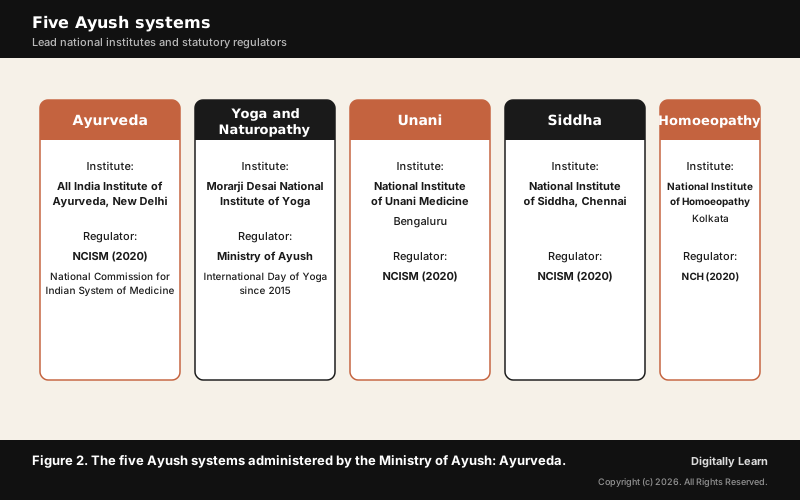
The Ayush Anudan Portal is a single-window digital grant-management system developed by the Ministry of Ayush under the Ayush Grid initiative for the submission, processing, approval, and monitoring of funding proposals under the Ministry's Central Sector Schemes. Ayush is the official acronym for India's five traditional and complementary medicine systems: Ayurveda, Yoga and Naturopathy, Unani, Siddha, and Homoeopathy, which are administered by the Ministry of Ayush at the Union level.
Why this is in the news on 20 May 2026
The Kartavya Bhawan launch
On 20 May 2026, Union Minister of State (Independent Charge) for Ayush Shri Prataprao Jadhav launched the Ayush Anudan Portal at Kartavya Bhawan, New Delhi. The portal sits within the Ayush Grid initiative and is designed to replace the manual paper-based grant-management workflow that earlier governed Central Sector Schemes administered by the Ministry of Ayush. The launch carried Minister Jadhav's wider remit, as he also holds the portfolio of Minister of State for Health and Family Welfare.
Definition: The Ayush Anudan Portal is a single-window digital grant-management system for the submission, processing, approval, and monitoring of funding proposals under the Ministry of Ayush's Central Sector Schemes. Anudan is the Sanskrit-Hindi term for grant or financial-aid disbursement. Ayush is the acronym for India's five traditional and complementary medicine systems: Ayurveda, Yoga and Naturopathy, Unani, Siddha, and Homoeopathy.
The Anudan Portal integrates with the NGO Darpan registration database operated by the NITI Aayog, which authenticates applicant organisations against their non-governmental-organisation registration record. The portal is also accessible through the Ministry's broader My Ayush Integrated Services Portal (MAISP), the single-window digital gateway that the Ministry rolled out for stakeholder services.
Portal architecture
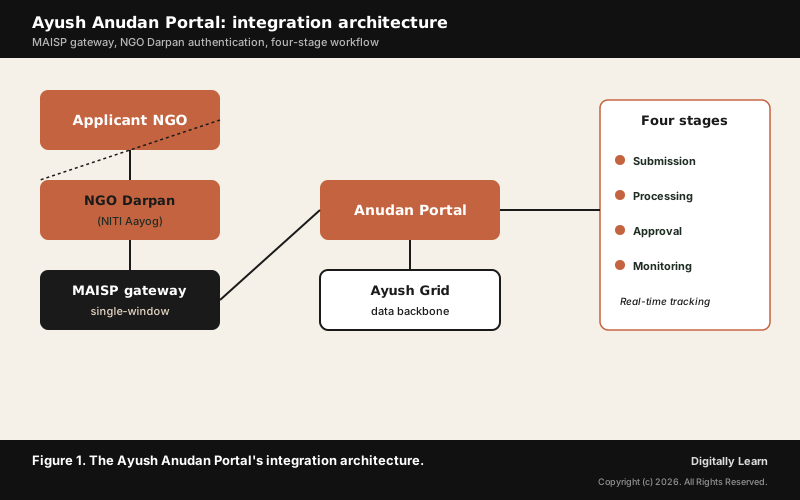
Why a grant portal matters for Ministry-of-Ayush administration
From paper-heavy workflow to single-window digital
Why it matters: The Anudan Portal addresses a documented friction in Ministry-of-Ayush grant administration. Before the portal, applicant organisations filed paper proposals at the Ministry's central office, submitted physical copies of NGO Darpan registration certificates, and tracked application status by telephone or email. Processing-time variance was high, the audit trail was fragmented across paper files, and grant approvals frequently slipped beyond the Central Sector Scheme's quarterly disbursement schedule.
Three workflow improvements emerge from the digital transition. The first is authentication: NGO Darpan integration verifies applicant credentials at the time of submission rather than at the back-end approval stage. The second is tracking: the real-time stage tracker lets applicants and officials monitor proposal status without separate correspondence. The third is auditability: the digital workflow generates a structured record that the Comptroller and Auditor General can examine without reconstructing paper files.
Significance for e-Governance and traditional-medicine policy
The significance of this launch
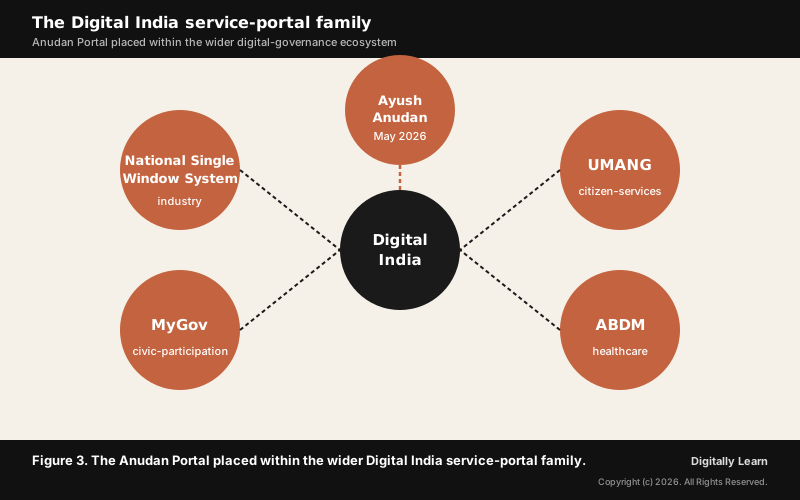
What is the significance of this issue: The Anudan Portal is significant for three reasons that span e-governance, traditional-medicine policy, and the broader Ease-of-Doing-Business agenda. The first reason is the e-governance dimension: the portal joins a wider Digital India family that includes the National Single Window System, the National Government Services Portal, and the Ayushman Bharat Digital Mission as integrated digital-service surfaces. The second reason is the traditional-medicine policy dimension: the Ministry of Ayush administers grants for research institutes, hospitals, educational establishments, and skill-development programmes across five traditional systems, and the portal places these grants on a common workflow. The third reason is the Ease-of-Doing-Business and Ease-of-Living dimension that has organised the Union government's digital-transformation agenda since 2014.
Structural reading: The Anudan Portal represents a small but characteristic instance of the API-and-database integration approach that the Ayushman Bharat Digital Mission has used at much larger scale. Integration with NGO Darpan replaces a verification step that the Ministry would otherwise have performed in-house; integration with MAISP places the new service on the Ministry's existing single-window gateway rather than spawning a separate URL. The architecture choice reduces marginal user-experience friction and lowers ministry-side implementation cost.
Distinguishing features of the Anudan Portal
How the AYUSH-Anudan portal is built
Distinguishing features: Three architecture features distinguish the Anudan Portal from a generic grant-application form.
- (i) Four-stage workflow on a single record. The portal carries each proposal through submission, processing, approval, and monitoring on one record with stage-marked timestamps. The four stages map onto the Central Sector Scheme grant lifecycle from application to utilisation-certificate submission.
- (ii) NGO Darpan and MAISP integration. Authentication runs through the NITI Aayog’s NGO Darpan registration database, and access runs through the Ministry’s My Ayush Integrated Services Portal (MAISP). Applicant organisations do not need separate credentials for the Anudan workflow.
- (iii) Ayush Grid backbone. The portal sits on the Ayush Grid, the Ministry’s data backbone that connects clinical, research, education, and grant-management services for the five Ayush systems. The Ayush Grid is the traditional-medicine analogue of the Ayushman Bharat Digital Mission backbone for modern medicine.
The AYUSH-Anudan portal at a glance
| Portal feature | Detail | Why it is examinable |
|---|---|---|
| Launch date and venue | 20 May 2026, Kartavya Bhawan, New Delhi | Fixed date in the e-governance chronology |
| Launching minister | Shri Prataprao Jadhav, MoS (IC) Ayush with MoS Health and Family Welfare | Ministerial responsibility |
| Administering ministry | Ministry of Ayush, Government of India | Successor to the Department of Ayush carved out in 2014 |
| Ayush systems covered | Ayurveda, Yoga and Naturopathy, Unani, Siddha, Homoeopathy | Five traditional and complementary medicine systems |
| Initiative | Ayush Grid (data backbone for traditional medicine services) | Analogue of Ayushman Bharat Digital Mission for modern medicine |
| Integration with NGO authentication | NGO Darpan (NITI Aayog) | One-time NGO-registration verification |
| Gateway | MAISP (My Ayush Integrated Services Portal) | Single-window Ayush services gateway |
| Workflow stages | Submission, Processing, Approval, Monitoring | Four-stage record on one proposal |
| Stated objectives | 100 per cent transparency, operational efficiency, strict accountability | Per Ministry of Ayush announcement |
| Wider policy frame | Ease of Doing Business, Ease of Living, and Digital India | Standing umbrella agendas |
Observable outcomes and operational metrics to watch
What to watch on the AYUSH-Anudan rollout through 2027
Observable outcomes: Six outcomes connect the launch event of 20 May 2026 to the broader e-governance and traditional-medicine policy track over the next twelve months.
- (a) Average grant-application processing time. The headline operational metric is the median number of days from submission to approval. A baseline of the pre-portal manual workflow and a six-month post-portal measurement together define the productivity gain.
- (b) Volume of applications routed through the portal. Total proposals submitted, broken down by Ayush system and by Central Sector Scheme, signals adoption depth among the NGO and institutional applicant base.
- (c) NGO Darpan integration coverage. Proportion of submissions auto-authenticated by NGO Darpan versus those requiring manual fallback, signalling the integration’s operational quality.
- (d) Utilisation-certificate turnaround. Time from grant disbursal to receipt of utilisation certificate at the Ministry, addressing the parliamentary-standing-committee concern on outstanding utilisation certificates in Central Sector Schemes.
- (e) Audit-trail readiness. Whether the portal’s digital records support direct CAG audit without manual reconstruction, the auditability outcome the launch promised.
- (f) Replication to other Ministry of Ayush services. Whether the architecture pattern (MAISP gateway, NGO Darpan authentication, four-stage workflow, and Ayush Grid backbone) generalises to clinical-establishment registration, educational-institution accreditation, and research-fellowship administration.
Contemporary linkages
Digital India, ABDM, and the wider traditional-medicine policy track
Contemporary linkages: Three threads connect the Anudan Portal to wider Indian policy currents. The first is the Digital India track: the portal joins MyGov, UMANG, the National Government Services Portal, and the National Single Window System as instances of the API-and-database integration template that the Digital India programme has standardised since 2015. The second is the Ayushman Bharat Digital Mission track: the Ayush Grid backbone is the traditional-medicine analogue of the ABDM backbone for modern medicine, and policy convergence between the two over time is a stated Ministry of Health objective. The third is the traditional-medicine global-positioning track: the World Health Organization's Global Centre for Traditional Medicine at Jamnagar, Gujarat (established 2022) creates an international platform for which the digitised Ministry grant-management surface provides domestic credibility.
UPSC Relevance
Where the Anudan Portal sits in the UPSC syllabus
UPSC context: The Anudan Portal falls within General Studies Paper II under the syllabus heads on government policies and interventions for development in various sectors, on e-governance applications, models, successes, limitations, and potential, and on welfare schemes for vulnerable sections of the population by the Centre. The topic also touches General Studies Paper III on digital infrastructure.
Prelims relevance: The Prelims surface includes the Ministry of Ayush as the administering ministry (formed on 9 November 2014 by upgrading the erstwhile Department of Ayush), the five Ayush systems (Ayurveda, Yoga and Naturopathy, Unani, Siddha, Homoeopathy), the NGO Darpan as the NITI Aayog registration database, the Ayush Grid as the Ministry's data backbone, MAISP as the single-window gateway, the National Commission for Indian System of Medicine (NCISM) Act, 2020, the National Commission for Homoeopathy (NCH) Act, 2020, and the WHO Global Centre for Traditional Medicine at Jamnagar (2022).
Mains relevance: The strongest Mains framing is the e-governance impact question: how do single-window digital portals reduce friction in Central Sector Scheme administration, and what are the empirical metrics for evaluating their success. A second framing is the traditional-medicine integration question: how does the Ministry of Ayush position Indian traditional medicine within the wider Indian health system and on the global platform that the WHO Global Centre at Jamnagar provides. A third framing is the Digital India track: how does the Anudan Portal fit within the wider API-and-database integration architecture that programmes like the Ayushman Bharat Digital Mission and the National Single Window System have established.
Mains practice question: A focused ten-mark question would read: Examine the Ayush Anudan Portal launched in May 2026 as an instance of single-window digital grant management. How does its NGO Darpan and MAISP integration architecture fit within the wider Digital India service-portal family, and what operational metrics will define its success? The answer should treat the four-stage workflow, NGO Darpan and MAISP integration, and operational metrics as the three spokes.
- Past Mains linkage. 2018 GS-II: How have the recommendations of the 14th Finance Commission of India enabled the states to improve their fiscal position? The Central Sector Scheme grant architecture that the Anudan Portal manages is the executive instrument that operationalises the Centre-state fiscal-transfer architecture the Finance Commissions design.
- Past Mains linkage. 2020 GS-II: ‘E-Governance is not only about utilization of the power of new technology, but also much about critical importance of the ‘use’ value of information.’ Explain. The Anudan Portal is a direct case study for this exact framing: the value comes from authentication-at-submission, real-time tracking, and audit-trail readiness, not from the technology itself.
- Past Prelims linkage. Prelims questions on the Ministry of Ayush, NCISM, and the WHO Global Centre for Traditional Medicine at Jamnagar test the institutional surface that the Anudan Portal sits within.
Previous Year UPSC-CSE Questions By the end you will be able to draft model answers for the following UPSC questions. Each question carries a collapsible framework showing how to approach it in the exam.
- UPSC Mains 2020 GS-II'E-Governance is not only about utilization of the power of new technology, but also much about critical importance of the 'use' value of information.' Explain.
How to structure the answer in the exam
Introduction: Open with a working definition of e-governance, name the Stephen Goldsmith / Indian-administrative-reform framing that distinguishes technology from information value, and signal that the answer will demonstrate the distinction through three categories of operational gains.
Body (sub-themes to develop):
- Authentication-at-submission as use-value: NGO Darpan integration with the Ayush Anudan Portal; Aadhaar-Pay platform; e-KYC at banking and mobile-services interfaces.
- Real-time tracking as use-value: stage trackers on Anudan, on Income-Tax Faceless Assessment, on PMAY application status; the Citizen Charter time-bound delivery framework operationalised through tracking.
- Audit-trail-readiness as use-value: digital records that the Comptroller and Auditor General can examine without paper-file reconstruction; the Public Financial Management System.
- Interoperability as use-value: API-and-database integration across Ministry portals; the Aadhaar federated identity layer; the Ayushman Bharat Digital Mission backbone.
- Risk-side: digital divide, data-protection (DPDP Act 2023), exclusion-error from biometric authentication failures.
Conclusion: Conclude that the quote's distinction is structurally correct, that the use-value emerges only when authentication, tracking, audit-trail, and interoperability are designed into the system from the start, and that the Anudan Portal of May 2026 is a small but characteristic instance of the architecture pattern that the wider Digital India programme has established.
The Anudan Portal is a direct illustration of the quote the 2020 question asks examinees to explain. The portal's use-value emerges not from the technology of HTML forms or database schemas but from the authentication, tracking, and audit-trail integration architecture. The Significance discussion of the API-and-database integration approach supplies the body sub-themes on each use-value category. The Contemporary linkages discussion places the Anudan within the wider Digital India service-portal family that the question asks examinees to draw on.
- UPSC Mains 2018 GS-IIHow have the recommendations of the 14th Finance Commission of India enabled the states to improve their fiscal position?
How to structure the answer in the exam
Introduction: Open with the constitutional role of the Finance Commission under Article 280, name the 14th Finance Commission chaired by Dr. Y. V. Reddy (2015-2020 award period), and frame the answer through three structural recommendations and their fiscal-position consequences.
Body (sub-themes to develop):
- Tax-devolution recommendation: vertical-devolution share of the divisible pool raised from 32 per cent to 42 per cent; immediate increase in untied state resources.
- Grant architecture: post-devolution revenue-deficit grants for states; local-body grants to panchayats and municipalities; grants for performance-linked sectoral interventions.
- Central Sector and Centrally Sponsored Schemes: the wider Finance Commission framework recommended restructuring CSS into a smaller set of umbrella schemes; the Anudan Portal of May 2026 sits within this CSS executive architecture for the Ministry of Ayush.
- Fiscal consequences for states: increased flexibility in deployment of devolution proceeds; reduction in centrally-tied funds; pressure on Centre to maintain Central Sector Scheme grants for sectors with strong national-public-good characteristics including traditional-medicine systems under Ayush.
- Finance Commission successor implications: 15th Finance Commission (2020-2026 award) under Dr. N. K. Singh; the 16th Finance Commission constituted under Arvind Panagariya for the 2026-2031 award period.
Conclusion: Conclude that the 14th Finance Commission substantially improved state fiscal autonomy through the 42 per cent devolution share, that Central Sector Schemes remained the executive instrument for sectors with national-public-good characteristics, and that grant-management portals like the Ayush Anudan operationalise the Centre's continuing role in such sectors.
The Anudan Portal is the executive instrument that operationalises the Centre's Central Sector Scheme grant architecture for the Ministry of Ayush. The 14th Finance Commission framework restructured the Centre-state fiscal-transfer architecture and pushed many erstwhile centrally-tied funds into the devolved pool, but Central Sector Schemes for sectors with strong national-public-good characteristics (including traditional-medicine systems under Ayush) remain with the Centre. The body sub-theme on grant architecture supplies the connection from the Finance Commission framework to the Anudan-managed grants.
Sources
- PIB release on Ayush Anudan Portal launch by Union Minister Shri Prataprao Jadhav
- Ministry of Ayush, Government of India
- NGO Darpan portal
- National Commission for Indian System of Medicine (NCISM) Act, 2020
- DD News: Ayush Anudan Portal launched to enhance transparency
- WHO Global Centre for Traditional Medicine, Jamnagar
- National Single Window System, Government of India
Editorial Disclaimer
This article is compiled from the reference materials listed in the Sources section. It is an explainer for UPSC preparation and is not a substitute for primary documents (NCERTs, GoI ministry releases, IMD bulletins, RBI / CEA / MoEFCC publications, and Standing-Committee reports).


