


Overview
Uniform Civil Code
Assam's UCC Bill bans polygamy, mandates live-in registration, and codifies gender-equal succession.
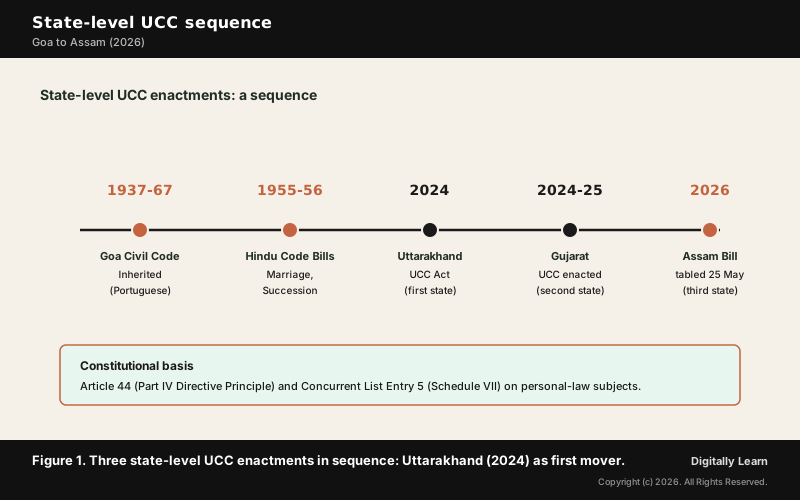
The Uniform Civil Code, Assam, 2026 Bill is a state-level statutory measure to standardise personal-law provisions on marriage, divorce, intestate succession, and live-in relationships for all residents of Assam except Scheduled Tribes. The Bill replaces multiple religion-based personal-law regimes with a uniform civil framework and follows Uttarakhand (2024) and Gujarat as the third state-level codification effort under Article 44 of the Constitution.
What the Assam Assembly did on 25 May 2026
The tabling and the legislative architecture
The Assam Government tabled the Uniform Civil Code, Assam, 2026 Bill in the State Assembly on Monday, 25 May 2026. Parliamentary Affairs Minister Atul Bora tabled the 154-page Bill on behalf of Chief Minister Himanta Biswa Sarma. The tabling fell on the third day of the first session of the sixteenth Assam Legislative Assembly, with merit-stage discussion scheduled for 27 May 2026.
The Bill drew opposition from Congress, Raijor Dal, and Trinamool Congress, who demanded wider stakeholder consultations before introduction. Congress leader Zakir Hussain Sikdar said the ruling Bharatiya Janata Party had moved to bulldoze the Bill without prior consultation. On 23 May 2026, at least ten Muslim religious and social organisations converged in Guwahati to press the government for stakeholder consultations.
Definition: A Uniform Civil Code in the Indian constitutional sense refers to a single civil-law framework that replaces religion-specific personal laws on marriage, divorce, succession, and adoption with rules of equal application across communities. Article 44 of the Constitution directs the State to endeavour to secure such a code for all citizens throughout India. The Assam Bill is the third state-level statute pursuing this objective after Uttarakhand (2024) and Gujarat.
Why the Bill matters for constitutional architecture
Constitutional and federal frame of personal law
Why it matters: Personal law in India sits across the federal architecture in a contested way. Marriage, divorce, infants and minors, adoption, wills, intestacy, and joint family property all appear at Entry 5 of the Concurrent List in Schedule VII of the Constitution. This concurrent placement opens space for state-level codification, while leaving the central legislature equally competent to enact a national framework.
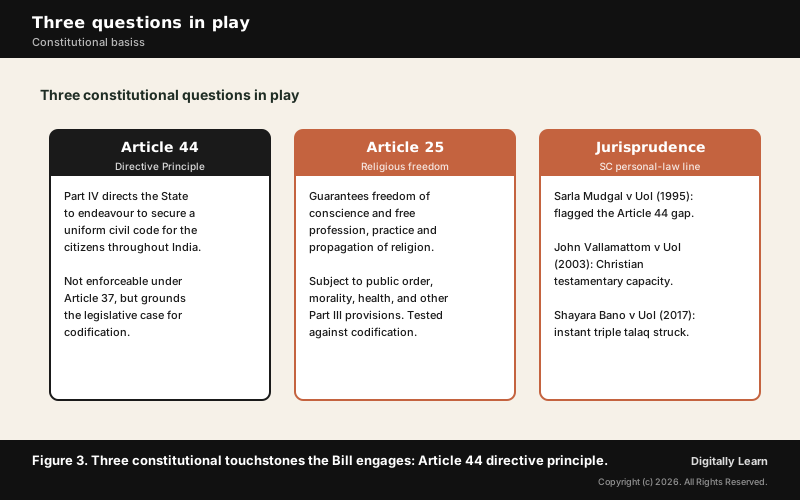
Article 44 of the Constitution sits in Part IV (Directive Principles of State Policy) and is therefore not directly enforceable by any court. The article does, however, make the constitutional case for codification and has been cited repeatedly by the Supreme Court, including in Sarla Mudgal v. Union of India (1995) and John Vallamattom v. Union of India (2003), to flag the legislative gap on uniform personal law.
Significance for personal-law jurisprudence
What is the significance of this issue: The Bill engages three constitutional questions at once. The first is Article 44's directive on uniform civil code as a goal of governance. The second is Article 25's guarantee of religious freedom, subject to public order, morality, and health. The third is the precedent line built through Shayara Bano v. Union of India (2017), which struck down instant triple talaq and signalled judicial appetite for personal-law reform.
A successful Assam enactment, alongside Uttarakhand and Gujarat, would establish state-level precedent for codification in the absence of a central UCC. A constitutional challenge under Article 25, or on federalism grounds touching personal-law uniformity, appears likely given the Bill's exclusion of Scheduled Tribes and its repeal of the Assam Compulsory Registration of Muslim Marriages and Divorces Act, 2024.
What the Bill says
What the Assam UCC Bill specifically does
Distinguishing features: Three structural features set the Assam Bill apart from earlier state-level codification.
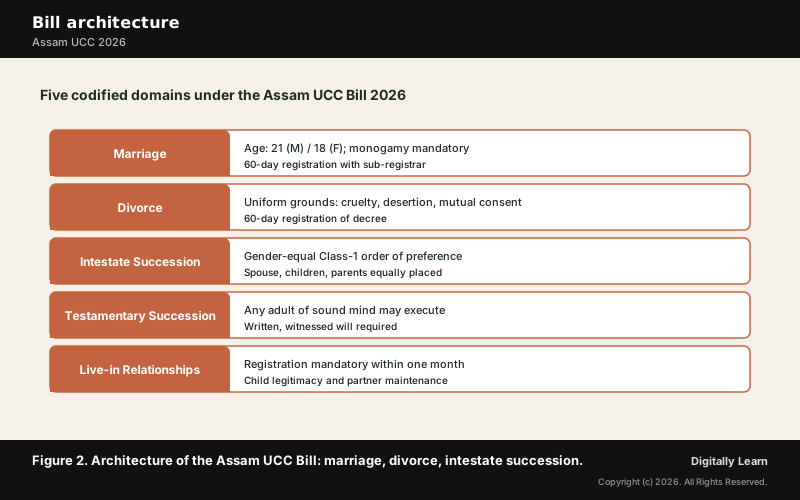
- (i) Polygamy and bigamy attract imprisonment up to seven years under Section 82 of the Bharatiya Nyaya Sanhita, 2023. The Bill mandates monogamy and sets the legal marriage age at twenty-one years for grooms and eighteen years for brides.
- (ii) Live-in relationships require registration with an appointed sub-registrar within one month. A child born of a live-in relationship is declared fully legitimate, and a deserted partner has explicit legal standing to claim financial maintenance through the courts.
- (iii) Intestate succession follows a uniform, gender-equal Class-1 order of preference that places the spouse, children, and parents on equal footing. Testamentary succession is open to any adult of sound mind through a written, witnessed will.
| Provision area | Uttarakhand 2024 | Gujarat | Assam 2026 Bill |
|---|---|---|---|
| Polygamy / bigamy | Banned; mandatory monogamy | Banned; mandatory monogamy | Banned; up to seven years jail under Section 82 BNS |
| Live-in registration | Mandatory with sub-registrar | Mandatory framework | Mandatory within one month; child legitimacy guaranteed |
| Intestate Class-1 order | Gender-equal heirs framework | Gender-equal heirs | Spouse, children, and parents on equal footing |
| Scheduled Tribe coverage | Exempted | Exempted | Exempted; ST share is 12.44% of state per 2011 Census |
Concept link for UPSC examination preparation
Concept link: The Bill connects to UPSC preparation through General Studies Paper II (Constitutional and Legal Issues, Statutory and Quasi-Judicial Bodies) and General Studies Paper I (Indian Society, Gender, and the Personal-Law Debate). Aspirants preparing the topic should note Article 44 in Part IV, Article 25 on religious freedom, Entry 5 of the Concurrent List, and the case-law trajectory running from Sarla Mudgal through John Vallamattom to Shayara Bano. The Goa Civil Code, inherited from the Portuguese codification, remains the only fully operational state-level UCC predating the 2024 sequence.
What the outcome could change
Observable outcomes if the Bill is enacted
Observable outcomes: Three concrete shifts would follow from enactment of the Assam Bill in its current form.
- (a) Assam becomes the third state with codified UCC, sharpening interstate divergence in personal-law application until central legislation harmonises the framework.
- (b) Constitutional challenges under Article 25 and on federalism grounds become likely, drawing on the earlier Uttarakhand challenges and the Bill’s selective exclusion of Scheduled Tribes.
- (c) Pressure intensifies on the central government to introduce or signal a national UCC, given the converging state-level codification template across three states.
How the penalty regime functions
The Bill prescribes a graded penalty regime tied to each codified domain. Eight offence-penalty pairs frame the enforcement architecture.
- Child marriage or marriage without valid consent: imprisonment up to two years, a fine, or both.
- Fraudulent or deceptive marriage through force, coercion, or concealment: imprisonment up to seven years along with a fine.
- Illegal dissolution of marriage: imprisonment up to three years and a fine.
- Compelling a divorced person to fulfil unlawful pre-remarriage conditions: three years imprisonment and a penalty of one lakh rupees.
- Marriage within prohibited relationships (unless protected by valid customs): imprisonment up to six months and a fine up to fifty thousand rupees.
- Deliberate non-registration of marriage or divorce within sixty days: a ten thousand rupee penalty.
- Forged or fabricated registration documents: imprisonment up to three months or a fine up to twenty-five thousand rupees, or both.
- Failure to register a live-in relationship within a month: imprisonment up to three months or a fine up to ten thousand rupees.
Contemporary linkages
The Bill in India's personal-law reform trajectory
Contemporary linkages: The Bill arrives within a wider sequence of personal-law reforms since the 2017 Shayara Bano judgment. The Muslim Women (Protection of Rights on Marriage) Act, 2019 criminalised instant triple talaq. The Assam Prohibition of Polygamy Act, 2025 already banned the practice within the state. The Compulsory Registration of Muslim Marriages and Divorces Act, 2024 introduced mandatory registration. The 2026 Bill consolidates and extends this trajectory into a unified civil framework.
Three contemporary considerations shape the discussion. The exclusion of Scheduled Tribes from the Bill's purview raises the question whether universal codification can coexist with constitutionally protected tribal autonomy under Schedule Six and Article 244(A). The codified treatment of live-in relationships marks a significant departure from prior personal-law statutes, which left such relationships largely unregulated. The savings clause regularising pre-enforcement polygamous marriages signals a transitional approach that may attract challenge on equality and arbitrariness grounds under Article 14.
Sources and Further Reading
- Assam UCC Bill seeks polygamy ban, registration of live-in relationships
- From polygamy and live-in relationships to inheritance: What Assam's sweeping UCC Bill seeks to regulate
- UCC implementation in Assam: Muslim organisations seek consultations with government
- Constitution of India, Article 44 (Part IV, Directive Principles of State Policy)
- Bharatiya Nyaya Sanhita, 2023 (Section 82 on bigamy)
- Shayara Bano v. Union of India, 2017
- Sarla Mudgal v. Union of India, 1995
- John Vallamattom v. Union of India, 2003
- Uttarakhand Uniform Civil Code Act, 2024
Editorial Disclaimer
Provisions of the Assam UCC Bill, opposition-side criticisms, and Supreme Court case attributions reproduce the Bill text and the reported statements as carried in the cited news sources. Readers preparing for the UPSC examination should consult the principal Bill text once gazetted and the Supreme Court judgments named for full context.


