


Overview
ICAR's Urea Alternative
ICAR urged states to promote ammonium sulphate as a urea alternative for kharif paddy amid West Asia supply concerns.
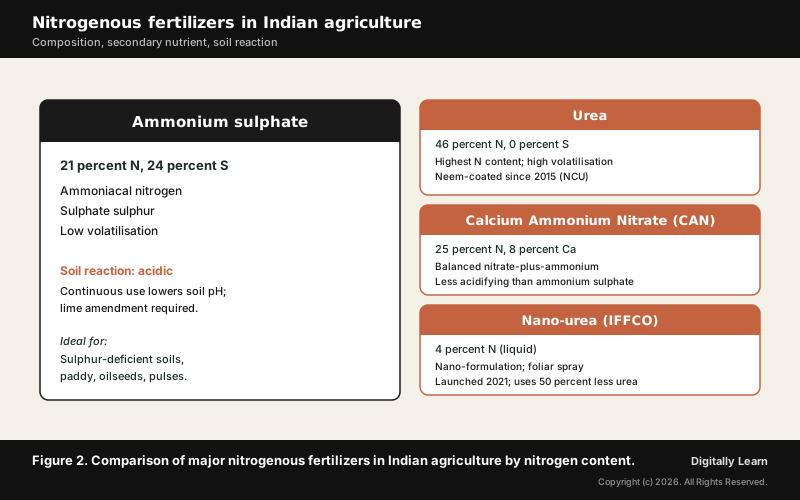
Ammonium sulphate ((NH<sub>4</sub>)<sub>2</sub>SO<sub>4</sub>) is an inorganic nitrogen fertilizer carrying approximately 21 per cent nitrogen in ammoniacal form and approximately 24 per cent sulphur in sulphate form. It is a dual-macro-nutrient fertilizer that addresses both nitrogen and sulphur deficiency in a single soil application. The Indian Council of Agricultural Research (ICAR), in a May 2026 advisory, asked state governments to promote ammonium sulphate as an alternative to urea for paddy cultivation amid supply disruptions from the West Asian conflict.
Why this is in the news in May 2026
The ICAR advisory and its supply-side context
In the third week of May 2026, the Indian Council of Agricultural Research issued an advisory urging state agriculture departments to promote ammonium sulphate as an alternative to urea for paddy cultivation in the kharif season. The advisory followed reports of urea-supply disruption attributable to the ongoing West Asian conflict, which has constrained the supply of natural gas that feeds urea-manufacturing units across India and globally. Ammonium sulphate, which is partly produced as a by-product of caprolactam and coke-oven processes and has a more diversified supply chain, was identified as a paddy-suitable substitute.
Definition: Ammonium sulphate with molecular formula (NH<sub>4</sub>)<sub>2</sub>SO<sub>4</sub> is an inorganic nitrogen fertilizer carrying approximately 21 per cent nitrogen in ammoniacal form and approximately 24 per cent sulphur in sulphate form. The dual-macro-nutrient supply means a single application addresses nitrogen demand and sulphur deficiency at once. The fertilizer dissolves readily in soil water and the ammonium cation binds to soil exchange sites until plant uptake, which reduces nitrogen volatilisation relative to urea on standing-water paddy fields.
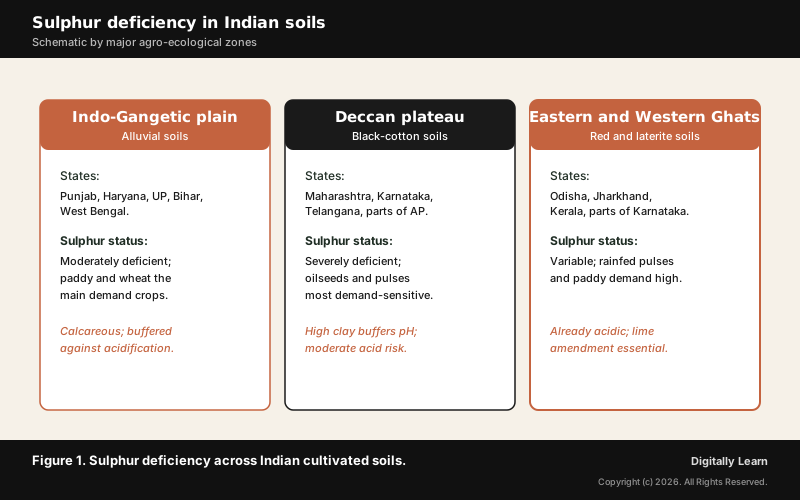
The advisory comes against the background of a documented sulphur deficiency across a large share of Indian agricultural soils. Sulphur, classified as a secondary macro-nutrient alongside calcium and magnesium, has historically been supplied passively through atmospheric deposition from coal combustion and through traditional fertilizers like single super phosphate. Modern intensive cropping with high-analysis fertilizers (urea, DAP, MOP) and falling atmospheric sulphur deposition have together produced widening sulphur deficiency that ammonium sulphate directly remediates.
Comparing common nitrogenous fertilizers
Why the advisory matters for India's fertilizer architecture
Supply-security and soil-health together
Why it matters: The advisory sits at the intersection of two simultaneous pressures on Indian agriculture. The first is fertilizer supply security: India imports a substantial share of urea raw materials (natural gas feedstock for indigenous production, plus imported urea for the import quota), and the West Asia conflict has elevated freight and feedstock costs across the supply chain. The second is soil health: long-running urea-DAP-MOP fertilization without sulphur supplementation has produced widespread sulphur deficiency that reduces both yield and protein quality of paddy and oilseed crops.
Ammonium sulphate addresses both pressures at once. Its diversified supply chain (caprolactam by-product, coke-oven by-product, direct synthesis) is less dependent on natural gas feedstock than urea, which buffers against West Asian crude and gas volatility. Its 24 per cent sulphur content directly addresses the secondary-nutrient deficiency that has emerged across the Indian Gangetic plain, the Deccan plateau, and the rainfed pulse and oilseed belts.
Significance for fertilizer policy and soil management
The significance of this advisory
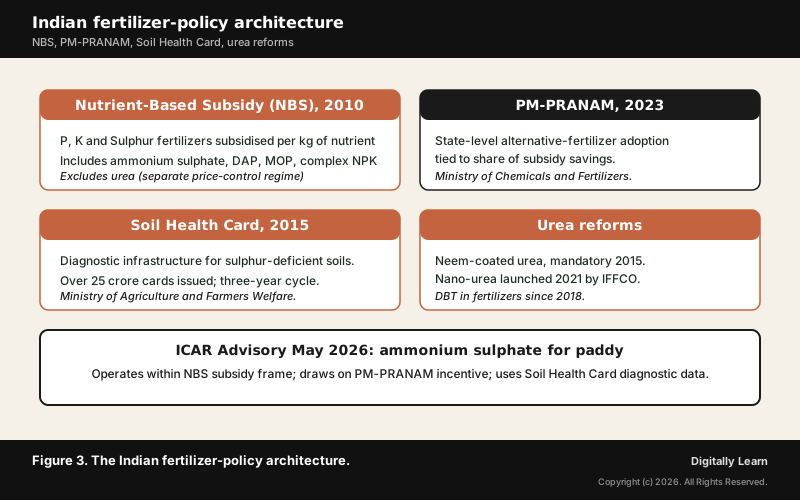
What is the significance of this issue: The advisory matters for three reasons that span supply policy, soil chemistry, and farmer economics. The first is the fertilizer-subsidy reason: urea operates under a separate centrally controlled price and subsidy mechanism while phosphorus, potassium, and sulphur fertilizers operate under the Nutrient-Based Subsidy (NBS) framework. Substituting ammonium sulphate for urea on paddy fields shifts a portion of subsidy outlay from the urea ledger to the NBS ledger and changes the on-farm price paid by farmers. The second is the soil-chemistry reason: ammonium sulphate is an acidifying fertilizer whose continuous use lowers soil pH and demands periodic lime amendment, which traditional urea does not. The third is the farmer-economics reason: the substitution decision depends on the relative subsidy-inclusive price per kilogram of nutrient delivered.
Structural reading: Indian fertilizer policy has progressed through three architectures since independence. The first was the Retention Price-cum-Subsidy scheme that fixed manufacturer-margin retention; the second was the Concession Scheme; the third is the current Nutrient-Based Subsidy regime introduced in 2010 for phosphorus and potassium fertilizers and extended to include sulphur and micronutrients. Urea remains outside the NBS framework on its own price-control mechanism. The asymmetric subsidy architecture distorts farmer choice in favour of urea, and the ICAR advisory operates within this constraint rather than overturning it.
Distinguishing features of the advisory
How the ICAR advisory shapes the kharif rollout
Distinguishing features: Three features shape how state agriculture departments translate the advisory into the kharif input regime.
- (i) Dual-nutrient supply. Ammonium sulphate supplies 21 per cent nitrogen and 24 per cent sulphur simultaneously. A single broadcast addresses both deficiency conditions that paddy fields face on intensified Gangetic-plain alluvial soils and Deccan-plateau black soils. Urea by contrast supplies 46 per cent nitrogen but zero sulphur and requires a separate sulphur fertilization pass.
- (ii) Lower volatilisation on flooded paddy. The ammonium cation in ammonium sulphate binds to soil exchange sites and resists volatilisation in the standing-water environment of transplanted paddy. Urea on flooded paddy hydrolyses rapidly to ammonia and loses a substantial fraction of applied nitrogen to volatilisation. Neem-coated urea (mandatory since 2015 for the subsidised category) reduces this loss but does not eliminate it.
- (iii) Soil-acidification trade-off. Continuous ammonium-sulphate application releases hydrogen ions during nitrification and lowers soil pH over time. The trade-off matters on already-acidic soils of the eastern Indian rainfed belt and the laterite-derived soils of the Western Ghats; on calcareous Gangetic-plain soils the buffering capacity absorbs the acidification effect for longer. Periodic lime amendment through agricultural lime or dolomite restores soil pH and is part of the recommended package.
The ICAR ammonium-sulphate advisory in numbers
| Fertiliser parameter | Detail | Significance |
|---|---|---|
| Chemical formula | (NH4)2SO4 | Ammonium-and-sulphate ionic compound |
| Nitrogen content | 21 per cent (ammoniacal) | Lower than urea but more stable on flooded paddy |
| Sulphur content | 24 per cent (sulphate) | Highest among major nitrogenous fertilizers |
| Volatilisation behaviour on flooded paddy | Low | Outperforms urea, comparable to neem-coated urea |
| Soil-reaction effect on long-term use | Acidifying | Lowers pH; lime amendment recommended |
| Subsidy framework | Nutrient-Based Subsidy (NBS), 2010 | Separate from urea price-control |
| Major production route | Caprolactam by-product, coke-oven by-product, direct synthesis | Diversified supply chain |
| Sulphur-deficient Indian soil share | Roughly 40 per cent of cultivated area | Standing context for the advisory |
| Issuing authority | Indian Council of Agricultural Research (ICAR) | Apex agricultural research body |
| Advisory date and target | May 2026; state agriculture departments for kharif paddy | Operational kharif window |
Observable outcomes the advisory must deliver
What to watch through the 2026 kharif and rabi seasons
Observable outcomes: Six outcomes connect the advisory of May 2026 to the operational kharif input regime and to the broader fertilizer-policy track.
- (a) Ammonium sulphate uptake in kharif paddy. Total tonnage of ammonium sulphate applied on paddy in kharif 2026, disaggregated by major paddy-growing states.
- (b) Urea consumption substitution. Percentage reduction in urea offtake on paddy fields where ammonium sulphate substitutes; baseline against kharif 2025.
- (c) Soil pH trajectory. Soil Health Card data on pH and sulphur status across the post-kharif sampling cycle.
- (d) Yield and grain-quality effect. Paddy yield per hectare and grain protein content compared between fields under ammonium sulphate and fields under conventional urea.
- (e) Lime-amendment adoption. Tonnage of agricultural lime and dolomite applied under state-level lime-subsidy schemes; proxy for soil-acidification management.
- (f) Subsidy outlay shift. Movement of fertilizer-subsidy outlay between the urea price-control ledger and the Nutrient-Based Subsidy ledger as a function of the advisory uptake.
Contemporary linkages
PMFME, PM-PRANAM, and the wider fertilizer-policy track
Contemporary linkages: Three threads connect the May 2026 advisory to wider Indian agricultural policy currents. The first is the fertilizer-subsidy reform track: the PM-PRANAM (Programme for Restoration, Awareness Generation, Nourishment and Amelioration of Mother Earth) scheme of 2023 ties state-level alternative-fertilizer adoption to a portion of the fertilizer-subsidy savings, creating an incentive for states to promote ammonium sulphate, organic, and bio-fertilizers. The second is the Soil Health Card programme of 2015, which provides the diagnostic infrastructure for identifying sulphur-deficient soils where ammonium sulphate is most directly indicated. The third is the National Mission on Edible Oils and the broader oilseed-self-sufficiency push, since sulphur deficiency limits oilseed yield more sharply than cereal yield.
UPSC Relevance
Where the ICAR advisory sits in the UPSC syllabus
UPSC context: The ICAR advisory falls within General Studies Paper III under the syllabus heads on major crops, cropping patterns in various parts of the country, different types of irrigation and irrigation systems, storage, transport and marketing of agricultural produce and issues and related constraints, and on government policies and interventions for development in various sectors.
Prelims relevance: The Prelims surface includes the nitrogen and sulphur content of ammonium sulphate (21 per cent N, 24 per cent S), its acidifying soil reaction, the Nutrient-Based Subsidy (NBS) regime introduced in 2010 for phosphorus and potassium fertilizers (and now extended to sulphur and micronutrients), the PM-PRANAM scheme of 2023, the Soil Health Card programme of 2015, the neem-coated urea mandate of 2015, the nano-urea launch of 2021 by IFFCO, and the institutional roles of the Indian Council of Agricultural Research and the Department of Fertilizers under the Ministry of Chemicals and Fertilizers.
Mains relevance: The strongest Mains framing is the fertilizer-policy reform question: how does the asymmetric subsidy architecture (urea price-control vs NBS for P and K and now S) distort farmer choice and what reforms would rebalance fertilizer use towards balanced nutrition. A second framing is the soil-health question: how do the Soil Health Card programme, sulphur deficiency, and acidification interact in determining the appropriate fertilizer mix for different agro-ecological zones. A third framing is the energy-and-supply-security question: how does India reduce dependence on natural gas feedstock for urea manufacturing and on West Asian crude for the broader chemical-fertilizer supply chain.
Mains practice question: A focused fifteen-mark question would read: The Indian Council of Agricultural Research's May 2026 advisory recommends ammonium sulphate as an alternative to urea for paddy. Examine the supply-side, soil-chemistry, and fertilizer-subsidy implications of this substitution. A well-constructed answer would treat the dual-nutrient advantage, the acidification trade-off, and the urea-versus-NBS subsidy asymmetry as the three spokes.
- Past Mains linkage. 2017 GS-III: What are the major reasons for declining rice and wheat yield in the cropping system? How is crop diversification helpful for stabilising the yield of the crop in the system? Sulphur deficiency and unbalanced fertilization rank among the documented causes of declining rice-wheat yield; ammonium sulphate is part of the response.
- Past Mains linkage. 2019 GS-III: What are the major challenges before crop diversification? How do emerging technologies provide an opportunity for crop diversification? Oilseed and pulse diversification away from rice-wheat is particularly sulphur-sensitive; ammonium sulphate is the conventional sulphur source.
- Adjacent linkage. 2018 Prelims tested on Soil Health Cards and Nutrient-Based Subsidy; both feature centrally in the operational architecture of the advisory.
Previous Year UPSC-CSE Questions By the end you will be able to draft model answers for the following UPSC questions. Each question carries a collapsible framework showing how to approach it in the exam.
- UPSC Mains 2017 GS-IIIWhat are the major reasons for declining rice and wheat yield in the cropping system? How is crop diversification helpful for stabilising the yield of the crop in the system?
How to structure the answer in the exam
Introduction: Open with the rice-wheat cropping system as the dominant cereal regime of the Indo-Gangetic plain, name the yield-decline evidence in long-term-experiment data, and frame the answer through reasons and diversification responses.
Body (sub-themes to develop):
- Nutrient imbalance: continuous urea, DAP, MOP without sulphur, zinc, boron; sulphur deficiency now documented across roughly 40 per cent of cultivated area; ammonium sulphate advisory of May 2026 is part of the response.
- Water-table decline: Punjab and Haryana groundwater depletion; Central Ground Water Board categorisation of over-exploited blocks; paddy as the largest groundwater consumer per hectare.
- Pest and disease pressure: rice blast, brown plant-hopper, wheat rust; herbicide resistance in Phalaris minor; the Integrated Pest Management response.
- Climate stress: heat-stress during wheat grain-fill in March; rising minimum temperatures in October-November affecting paddy harvest; the National Innovations in Climate Resilient Agriculture programme.
- Crop diversification response: oilseeds and pulses replace some paddy area; the Crop Diversification Programme in Punjab and Haryana; PM Krishi Sinchayee Yojana water-efficiency component; the role of Sub-Mission on Agroforestry.
Conclusion: Conclude that declining rice-wheat yield reflects nutrient imbalance, water stress, pest pressure, and climate stress in combination, that crop diversification stabilises yield by restoring soil nutrients and spreading climate-risk, and that targeted advisories like the ICAR ammonium-sulphate recommendation of May 2026 operate within this broader response.
Sulphur deficiency is one of the named nutrient-imbalance causes behind declining rice-wheat yield. Ammonium sulphate is the canonical sulphur-supplying nitrogenous fertilizer, and the ICAR advisory of May 2026 places it within the broader response to the yield-decline pattern. The body sub-theme on nutrient imbalance maps directly onto the Significance discussion of the asymmetric subsidy architecture and the Distinguishing-features discussion of the dual-nutrient supply.
- UPSC Mains 2019 GS-IIIHow can the 'Digital India' programme help farmers to improve farm productivity and income? What steps has the Government taken in this regard?
How to structure the answer in the exam
Introduction: Open with the Digital India programme's reach into rural India, name the four categories of agricultural digitalisation (information, market, advisory, finance), and signal that the answer covers both the productivity-income mechanism and the named interventions.
Body (sub-themes to develop):
- Information-side digitalisation: Kisan Suvidha mobile app; Kisan Call Centres; meteorological advisories from the India Meteorological Department; the Crop-Cutting Experiment digitisation under General Crop Estimation Survey.
- Market-side digitalisation: electronic National Agricultural Market (eNAM) launched 2016 connecting over 1,300 mandis; agricultural-marketing reform path through the model APMC and contract-farming acts.
- Advisory-side digitalisation: Soil Health Card programme generating sulphur-deficiency and other nutrient diagnostics; ICAR advisories like the May 2026 ammonium-sulphate recommendation operating on Soil Health Card data; KCC (Kisan Credit Card) digital management.
- Finance-side digitalisation: PM-Kisan direct-transfer of 6,000 rupees per year per eligible farmer; Pradhan Mantri Fasal Bima Yojana satellite-driven settlement; fertilizer DBT since 2018 transferring subsidy on point-of-sale.
- Productivity-income outcomes: precision agriculture in pilot cluster blocks; crop-yield forecasting models; market-price-spread reduction through eNAM transparency.
Conclusion: Conclude that Digital India tools in agriculture address each link in the farm-productivity chain from soil diagnosis to market settlement, that the Soil Health Card and ICAR advisory architecture together drive the precision-fertilization response of which the May 2026 ammonium-sulphate recommendation is a current instance, and that the cumulative gain depends on continued investment in the rural digital infrastructure.
The ICAR advisory is delivered through the digital advisory infrastructure that the 2019 question asks examinees to evaluate. The Soil Health Card programme of 2015 generates the sulphur-deficiency diagnostic that justifies the advisory at the per-farm and per-block level. The body sub-theme on advisory-side digitalisation supplies the direct connection from the question's framing to the Contemporary linkages discussion of the Soil Health Card and PM-PRANAM frameworks.
Sources
- Indian Council of Agricultural Research
- Department of Fertilizers, Ministry of Chemicals and Fertilizers
- Soil Health Card scheme, Department of Agriculture and Farmers Welfare
- Indian Farmers Fertiliser Cooperative Limited (IFFCO)
- Ministry of Agriculture and Farmers Welfare
- Press Information Bureau release on PM-PRANAM scheme
- Wikipedia: Fertilisers in India
Editorial Disclaimer
This article is compiled from the reference materials listed in the Sources section. It is an explainer for UPSC preparation and is not a substitute for primary documents (NCERTs, GoI ministry releases, IMD bulletins, RBI / CEA / MoEFCC publications, and Standing-Committee reports).


